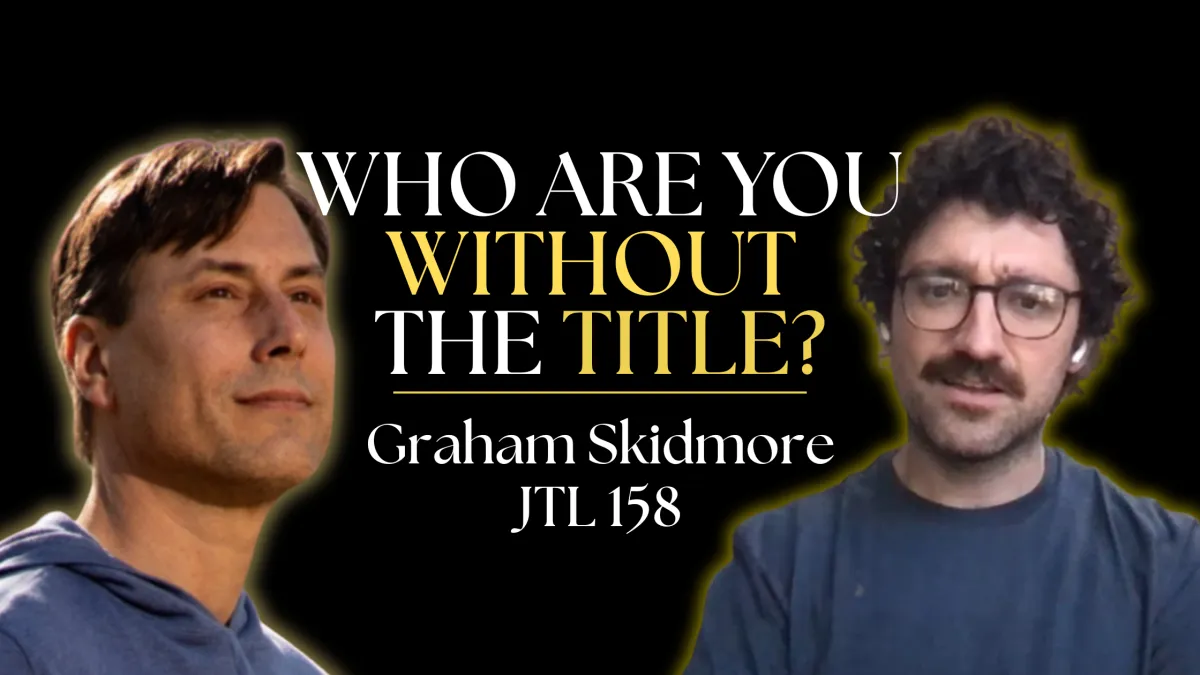
Career Burnout | Graham Skidmorew
Want to hear the full conversation? Listen to the Journey To Legacy podcast Episode 158 with Graham Skidmore for even more insights and stories from his remarkable entrepreneurial journey.
Career Burnout: What Happens When Your Job Becomes Your Identity?
At the height of his success, Graham Skidmore was also at the height of his misery.
He had spent 20 years helping Quicken Loans, now Rocket Mortgage, grow from around 400 employees to 20,000. He reached the executive level, led a smaller company as CEO and earned a high six-figure income.
Then, during a conversation with his CEO at Starbucks, Graham admitted that he no longer knew who he was.
His experience reveals one of the less obvious dangers of career burnout. Work can become so closely tied to your identity that losing the role feels like losing yourself.
What is career burnout?
The World Health Organization defines burnout as an occupational phenomenon caused by chronic workplace stress that has not been successfully managed. Its main signs include exhaustion, growing mental distance or cynicism toward work and reduced professional effectiveness.
Career burnout can also affect how you see yourself, especially when achievement has become your main source of confidence or belonging.
Graham described his identity as being wrapped up in his performance. A difficult quarter felt personal. Professional criticism struck deeper than feedback about a task. Even golf on the weekend became a way to release enough pressure to survive Monday.
Signs your job has become your identity
The warning appears when your role starts carrying the full weight of your identity.
Common signs include:
You struggle to describe yourself without mentioning your work.
A professional setback feels like proof that you are failing as a person.
Achievements provide less satisfaction than they once did.
Weekends are spent recovering rather than enjoying your life.
You keep chasing the next goal because slowing down feels uncomfortable.
You feel unsure about what you value outside your career.
Your body may notice chronic stress first
Career burnout is not always announced by one dramatic breakdown. It may build through poor sleep, low energy, irritability, tension or a constant sense of dread before work.
Graham also spoke about heartburn, digestive problems and back pain. These symptoms can have many causes and should be discussed with a healthcare professional. When they appear alongside exhaustion and unhappiness at work, they deserve attention.
Your body can provide information without providing the diagnosis.
Why a career setback can become a turning point
After leaving corporate life, Graham joined a golf trip in Las Vegas. He met men who spoke about getting fired like it was a badge of honor. Losing a job had pushed them to start companies and consider opportunities they may otherwise have ignored.
Graham could not see his own transition that way yet. His title was gone and his professional identity had taken a serious knock.
Harvard Business Review describes career disappointment as something people must actively process before moving forward. The opportunity may only become visible after the initial loss has been acknowledged.
How to rebuild your identity outside work
Start by separating your abilities from your title. Your role may end, but the judgment, experience and skills you developed remain yours.
Next, pay attention to what gives you energy outside professional achievement. Relationships, creativity, faith, movement, service and learning can all hold parts of your identity that work has crowded out.
Finally, question the environment as well as yourself. Graham spent years receiving advice designed to help him fit into the existing corporate box. His progress began when he found people willing to understand how he was wired before telling him who to become.
This process rarely happens overnight. Our guide to getting out of your comfort zone offers a practical way to identify where change could begin.
Your title tells people what you do. It should never have to explain everything you are.
Listen to Graham Skidmore's full conversation on the Journey to Legacy podcast for more on career burnout, professional identity and rebuilding a life that feels like your own.
TRANSCRIPTS:
WAYNE: Welcome back to Journey to Legacy. My guest today, he had everything a person could want. A high six-figure income, a C-suite title, a position in one of corporate America's most influential marketing operations at Rocket Mortgage. And then one day, sitting in Starbucks with his CEO, he realized something kinda terrifying.
He had no idea who he was anymore. He'd become nothing but an accumulation of learned behaviors and habits, performing a version of himself that was slowly destroying him. Little did he know that losing his corporate identity would become the catalyst for discovering who he actually was. Before that breakdown could lead to a breakthrough, he'd have to hit some serious rock bottoms.
He'd go through eight years of therapy and coaching, looking to find himself and also to rebuild his entire understanding of success and purpose. My guest today, Graham Skidmore, founder of Saff Solutions and co-founder of Harmony Health Institute. Graham is a former corporate executive turned systems architect who discovered that the systems destroying his life were the same ones he'd spent twenty years perfecting.
In this episode, we explore how burnout and collapse can become initiation rather than failure, why the signals that your body sends matter more than the metrics your title promises, and how authenticity turns out to be more efficient than acting like the person you think you're supposed to be. This is the episode for anyone who's climbed the ladder and unfortunately realized it was leaning up against the wrong wall.
Let's dive in with our guest, Graham Skidmore.
Thanks, Graham and so jumping right in, why don't you tell us a little bit about who you are, what you're working on, maybe why you believe people should listen to you today
GRAHAM: So hey, Graham Skidmore, thanks for having me. Really appreciate it and excited and just looking forward to our conversation here. As far as, gosh, what got me s- you know, kinda what got me here and things like that, I can go into the detail if if you want if we feel it's relevant.
But, you know, eight years ago I left the corporate life. Similar story to a lot of people, right? Which was the height of my success, was the height of my misery, my burnout, my lack of purpose, and going, "Look, man, I played the game of life. I checked the boxes, but I feel horrible. Something's gotta give. This can't be right."
Right? I did everything I was supposed to. I've got access to the best healthcare, right? I've got access to concierge medicine. I can... I've got access to executive coaches, et cetera, et cetera, so why isn't some of this stuff working? Anyhow, and so that led me to stepping away from corporate life until I could figure out how to become and feel healthy, happy, again and comfortable in my own skin.
Now, when I stepped away, I had no idea that it was gonna lead me down the journey that it did, but through my own experiences, I recognized, shortcomings that are out there in, in product offerings in the medical community, et cetera. And then that's what led me to kinda creating my next companies or chapter of life, and going from working for somebody else into, work- you know, now being as an entrepreneur, working for myself with a little side of activi- activism and mysticism fueling.
WAYNE: mysticism, feeling it. love it. We're gonna dive through, and please share as many stories in this journey as possible. 'Cause as we talked about earlier before recording, it's like oftentimes the difficult pieces, the transitions get talked about few, but it's what everybody goes through, and it's oftentimes what matters the most, what makes the most impact. And so I'm curious, you said that in corporate you were at the height of your career. What did you say here? Yeah, height of success and career, but it was also the height of your misery. What do you mean? Tell, tell me more. How did those things add up together?
GRAHAM: Yeah, and before I do that, I'm gonna... i'll share a quick story, which, look, I think it's something that anybody who's had a level of success and then doesn't have things go their way struggles with, and then this, and it is advice that somebody gave me, and it took me, I don't know, many years after hearing it to get it to kind of sink in.
And it was mutual but not mutual because it was kind of unexpected for all parties when I parted with my corporate life, right? We all thought I would just kind of be there forever. And so I was on a Vegas on a golf trip with some people s- you know, actually most of them I didn't even know, and we were riding on the way to the golf course.
And the guys that, we were all... And out here I am sitting there bummed out, feeling like my ego's a little deflated. My identity's a little ruffled because I don't have this corporate background behind me as part of who I am to represent me anymore, right? That was a very challenging, , thing for me.
And the guys are all looking at me, and they're all like, they're like laid back and they're chilling out, and they're all, wearing how they got fired with a badge of honor, right? Because for them, when they got fired, that was the thing that f- that s- was the spark or the catalyst that led them to go build their own company, do something else, be innovative, et cetera, et cetera, right?
And so they were like, "Oh yeah, man, best thing that's ever happened to me. It was great." And here I am going, "Oh man, I don't know what I'm gonna do." Like there's a part of me on the outside, I feel really tough and comfortable and confident. On the inside, man, I don't know what the heck I'm gonna do.
Right? So anyway, being able to... I, so I think that, there's a lot of entrepreneurs that have that same story, right? And so I think that's a really important part of the transition, is not allowing our identity to be so wrapped up in our career that it inhibits the options and opportunities we see available to us, right?
And again, that was something that, you know, again, that's been talked about plenty of places. But even knowing that and even hearing that, I still had to get to a spot where I could Embody that and be authentic, not just fake it till you make it, right? Anyhow, but so going back to your question, the height of my success, yes, I was, the typical boxes.
I was in the C-suite of a 20,000-person organization. I'd been there for 20 years. Had different comp... You know, there was like a parent company and then other, other companies underneath it, right? , I had my position inside the large organization. I also was a CEO of one of the smaller companies and had another smaller company that reported to me.
I got to be an innovator, an inventor, a CEO and without having to take on all the risk, throughout a l- lot of my career. And, and it was all in the marketing, client acquisition, aspect. Quicken Loans, Rocket Mortgage was the company, so I was, responsible for a lot of the client acquisition and strategies, that took us to the number one position and left they d- you know and then shortly after I left is when they became number two, whatever.
I'm not saying those things are correlated. I'm just saying I was there for the ride at the top, and that was a lot of fun and a really cool experience to be able to have and draw from in, in the future. And then, yeah. And that was all that I ever knew. That was the only corporate life that I'd ever had.
It was the only job I'd ever known. And, look, man, I, Even though I didn't, fully understand myself and my wiring, I knew that I was wired differently. I knew that I w- had challenges with communications or miscommuni- or being misunderstood and things like that. And so when I left the corporate house, there was a part of me that I knew I was strategically and tactically uber competent.
But the softer skills, the people skills, the soft touch around the green, I knew those were challenges of mine, and I didn't... and, and I just didn't know what was out there. I didn't know what I didn't know. And yeah, I had a very just had a very humbling experience trying to find my way, after my corporate after my initial corporate background, whether it be talking with other companies, pitching other companies, staying in the same space in the mortgage industry before deciding to abandon that and realizing that wasn't the next chapter of my life.
But anyway, yeah let me kick that back to you before I go down any other rabbit holes.
WAYNE: Yeah. Graham, first off, please go down rabbit holes. I'm all for them for the rest of our time here together. But this is always interesting to me 'cause I actually come across a good amount of entrepreneurs, leaders, individuals that seemingly had the life of everyone's dreams, You're the, the right? You're sitting pretty. You're making, I would argue, who knows, but probably the most money you had ever made, right?
You have the house, the cars, the country club. What was it that wasn't feeling right? Like, where... Help us see, what is the misery that was going on?
GRAHAM: Yeah. So my whole id- so first off, my whole identity was wrapped up in my career, right? In my performance and my achievements and things like that. And so when things-- So whenever things weren't going well, it was very personal, right? And I'm not one of those people that b- no matter what, I believe that, there is a certain element of work that's personal.
I'm giving up eight hours or 10 hours of my day. It's personal. That doesn't mean it's who I am, right? But there's a certain personal component to it. And it... But when I-- But when there were challenges, then it just hit me twice as hard as it did maybe some other people who didn't have so much their identity, right?
And so that's just kinda like an important foundation to recognize when I, when things, when I would get rocked by certain things. And one of the things that was hard for me was that the skills and abilities that were needed and appreciated in a company that was going, that went from 400 people when I joined to 20,000 people when I left is very different than the skills and abilities that are needed to maintain an existing company of 20,000 people, right?
And for, so for me, a little bit of being rough around the edges or, my ability to always get the job done, but sometimes leave a few, dead bodies in the wake was acceptable means of doing business when the organization was growing. But when it came time to sustaining, right?
The... That just wasn't the right, that wasn't the right combination. It's never the right combination, but it certainly wasn't as acceptable as what it was, in that sustaining mode and the ab- and the need to be able to be a communicator, have a certain type of stage presence, et cetera, it was not something that I had spent time developing for myself, and then all of a sudden, boom, those were the skills of mine that were needed, and it became very uncomfortable.
I was very-- I wanted to be a person that was just more behind the scenes. I didn't wanna be out there in the spotlight. I actually didn't wanna be a part of the C-suite. I had to be, right? And s- and I remember being in Starbucks with Jay, the CEO at the time, and I was like, man, Jay-" I don't even know, like I feel like I don't even know who I am anymore, right?
I feel like I've just become con- a an accumulation of learned behaviors and habits trying to get by. And I don't even know... So I don't even know who I am, what makes me happy. My whole life is built around the ability to go to work, right? I go on the weekends and I play golf to blow off the steam just so that I, just so that I've got room in the tanks to deal with the stress come Monday.
It's not even like I'm getting ahead. I'm just constantly just trying to get by. And so e- after a while and then, not enjoying who in the mirror, not recognizing who in the mirror, you go, "Man, why the heck am I doing this?" And the things that used to work for me, that would make me feel better, a, a career accomplishment, hitting quarterly numbers th- exceeding goals, stuff that before used to make me feel good and, or that used to elevate me, they just d- it wasn't having that same effect anymore, right?
And so then and so anyhow, then yeah, that just led to the other vices that I used to get by, boozing, gambling, partying. Those, those ones certainly don't help your career, let me tell you.
WAYNE: Yeah
GRAHAM: when in excess. But that was what, that was what I was like, look, I'm just trying to get by.
So that's where I was leaning into because it was so much, in the pressure cooker Monday through Friday that I had to find an equal release come Saturday, Sunday. And anyhow, and so all those things caught up with me and I just became, When I say caught up with me, it just means that, I certainly would, come to work more tired on Monday.
I'd have less energy. I'd have less patience. And it just became not enjoyable, right? And then that, then that obviously spreads through to conversations, patience with others, take your pick. And so all of a sudden then it led to, one day me and the CEO sitting down and he's like, "Hey, some of the stuff that just isn't working and this isn't working."
I'm like, "No, it's not." And he's like, "Hey, let's make some changes." And I'm like, "Okay." And then it ended up being, "All right, yeah, and I'm just gonna leave."
WAYNE: Yeah.
GRAHAM: And yeah.
WAYNE: Interesting this piece where you said you had this realization that you had become this conglomerate of learned behaviors to help you just get by, and you had lost who you actually were, Looking back, before it reached this point you saying these things to the CEO or you two sitting down of agreeing now change needs to happen, do you think there's a point that you could have realized it earlier?
Were there signs? And I'm trying to think about specifically some listeners here, right? That they're in the position you were in, or they are two years from it, What were maybe some of those signs that people could be looking out for to realize, "Let me start to make change today"?
GRAHAM: Man, I was in it for years before it finally got to me. It may have even been five, five years. I knew that, like I knew for probably three to five years that the writing was on the wall that I was b- that my, the way that my future looked was not gonna be the way it actually played out.
I was gonna have to leave the organization. And so I did everything that I could trying to fight that. The, some of the things along the way for me was, you know you got a problem when people tell you, "Look, man, just be yourself," and then just being yourself gets you in all kinds of shit.
You know you got an uphill battle when being yourself is the thing that's causing you problems.
WAYNE: Just say anything
GRAHAM: A- and being yourself, that doesn't... Look, man, I was not some- I was not one of those guys who was I'm not out there throwing phones at people and like swearing and necessarily breaking people down, but I was somebody who didn't have empathy.
I didn't necessarily, and I definitely didn't give people sympathy. I wasn't, I didn't demonstrate compassion. I didn't demonstrate appreciation or gratitude. Like I was just very matter of fact. Sometimes I was even called a taskmaster at one time, right? Because I was just matter of fact, we're here to get the job done.
Let's do what we gotta do. And then let's move on, right? And, for years people would say to me, "People don't care how much you know until they know how much you care. You can't command respect without giving it." And you- and so I would say, "Hey, when people start giving you little hints like that, that should be your first clue that they're just being nice and polite and trying to draw your attention to something."
Now again, for me, what I really needed was for s- was for somebody to mo- to be more direct with me the way that I was direct with other people and go, "Look, man, you think you're doing this, but this is how it's being received." And every time that I tried to have some of those conversations with HR or some of the coaches, et cetera, it became like either, "Hey, Graham, why are you being so defensive?"
I'm not being defensive. I'm saying that what you're telling me doesn't make sense. I obviously have, have no desire to hurt so-and-so's feelings consciously or intentionally. So I need you to walk me through how I did that so that I can understand it so that I know not to do it again. If you just telling me, "Don't hurt their feelings," doesn't help my cause, and most likely I'm gonna hurt their feelings again because I don't recognize what I'm doing, right?
And so again... So having, finding ourselves on these hamster wheels or having some of these conversations, I think is one of those things where in hindsight, now I probably should've been able to step back and just been like, "Okay, look, something's not going right." Instead of just assuming that my next achievement will be enough to overshadow these concerns, I should just step back and go, "You know what?
I need to really put some dedicated time and focus to this, and I really need to talk to y'all, and I need to talk to my people too, because I know that's not how I want them to feel." And so I need to figure out how to close this gap between here's how I think about you and here's how I feel about you compared to here's how you think that I think and feel about you, and how can I be more open and honest or whatever, what that, whatever was needed, at that time.
And so I really struggled along for a few years trying to find my way, trying to find that connection with people, trying to overcome those challenges. And thankfully, and frankly one of the things that finally helped me to get it was that I had three leaders that reported to me, and each one of them represented a part of me, which was the one represented the snarkiness, one represented the know-it-all And one represented the so it was the snarkiness, the know-it-all, and then what was the...
Oh, and a bit of the unapproachability. And so what I got a chance to do was I got a chance to watch in meetings how other people worked with them. Whoa, got a little camera zoom in right there. How the, how... Must be in a serious point here. And so I got a chance to watch how the room responded to them, how they shut down the room, how the room was receptive.
So I got it-- and that was probably one of the most helpful things I got a chance to learn because especially if you're like the, the quote unquote, "The leader or the boss," people put up with a lot of your crap, right? And people give you a lot of smiles, and it's really hard to get honest feedback. And so this was a way for me to get that honest feedback, almost like an out-of-body experience.
And I realized, I was like, "Wow, I see how the room is laughing, but how they're really shutting down behind those laughters. I see how the people are wanting to say things, but they're biting their tongue because they don't wanna get the snarkiness back or the shit back from, from the presenter."
And I was like, "Wow, okay, I see how I'm now having these unin- these effects on people that I'm obviously not wanting to." And so that was, that really helped me to figure out some things and to improve my comm- im-im-improve relationships. The ch- the challenge was at that time, just like a nail in the wood, right?
Once you, you can pull the nail out of the wood, but the hole is still there, and so I still had a lot of that stuff to deal with in, in relationships and otherwise. But anyway, that was probably the biggest turning point for me that helped me to start to allow to myself to be on the same page as what everybody else was, and then recognize where the disconnects were occurring, and that greater sense of awareness and self-awareness that helped me to be more patient with people, recognize that when I thought I was being funny, I was more or less coming off like an ass, or where I thought that I was being engaging or was trying to share knowledge was coming across as, the know-it-all, et cetera.
And then that led me to really having some very significant changes in delegation, being able to ge- understand what people meant by giving others respect and what that looked like and showing that I did, appreciate and value them, which, I apparently wasn't, I wasn't doing before, et cetera.
But still, at the end of the day, I was still in a situation in a company that I was not my genuine and authentic self, nor did I feel that I could be. And shit, at that point, I didn't even remember who that was at that point in time, right?
WAYNE: Yeah.
GRAHAM: just, I knew that I could improve things for the immediate s- my, my immediate circle, but that wasn't going to fix the long-term problem I had, which was in order to still be here and do what I'm doing, I've gotta be who I'm not.
WAYNE: Wow. Interesting, right? In order to move forward, you have to be who you're not. Okay, so you, this realization over years of seeing, okay, there's a lack of empathy going on, a lack of compassion or patience or gratitude, right? Was really building up, and it was this realization of everybody around you even saying, like, giving you these little tips of gonna realize how much you know until they know how much you care," right?
These are, like, started to be hints. And let's take two steps forward, right? And so you've left the corporate world now. Where did you begin? Like, how did you start to find who you truly are again? Because there's probably so many people out there that think "No, this is who I am." Their whole identity is caught up in their day-to-day, in their title, right?
And they're realizing maybe this isn't who I am, but where do I begin to even figure out who that true person is?"
GRAHAM: I had to hit some bottoms and go through some tears through m- many cycles of that, frankly. I kinda figured out a secret sauce, and so I left feeling very confident and cocky in, that others were gonna want this secret sauce, that I was gonna... You know what I mean? do, do great.
It was gonna be, an easy cakewalk for me in this next chapter of my life. Couldn't have been further from the truth. People didn't, because, when you figure something different out, you figured out something different because you understand things differently, things differently, you talk about things differently, you solve them differently.
Not everybody wants to do differently. Some people wanna do simple anyway. And and so needless to say, what I was pitching wasn't, wasn't making sense, and it wasn't necessarily resonating, or it was maybe too out there, or maybe I wasn't doing a great enough job of connecting dots.
Either way, I recognized that, this wasn't working, and frankly, it was what I knew, and so it was what I pursued, and it was really being driven by money, right? I want money. I need money, and so let me go find a way to make money, and that was what I knew. But it's... So that goes went back to that same thing, which was, in order to do this, I've still gotta be somebody that I'm really not, right?
And so it, look, the universe has its way of making sure that you learn your lessons and giving you the kind of guidance that you need. And it just wasn't part of my next journey to stay in the mortgage industry. And so no matter how many people I talked to, the universe was gonna make sure that I realized that I didn't have to have that success and get distracted from really where I needed to be.
And that kinda led me down the path of, between that and some tears and some frustrations, all, you know, emotions that, that sometimes bring that, that, that truth to the surface, where one day I, just had a kind of a breakdown and, that was... and just realized that I needed to focus on myself first before I worried about any career stuff.
And so that kind of led me down a path of focusing on my own health and wellness journey, which was, which t- which included the Western, the Eastern, the Indigenous, and the spiritual and an integration of all of the, all of those to help me get back in touch with who I was, who I am, who I want to be, what feels good, and what that then meant for my next chapter of life.
And, and and along that way, there was a lot of, again, frustrations, me trying to do things my own way, universe going no," and learning a lot of lessons the hard way through that through that process and journey. But that's, but then I, I finally, peeled away all of the learned behaviors, habits, guilt, shame, fear, trauma, anxiety, et cetera, to find myself again, right?
And to find what made me feel good and what made me feel whole. And that was what I used to to fuel and understand the next chapter of my professional life
WAYNE: Wow. Where do you think was the turning point that, you left the corporate and you thought, "Okay I'm the secret sauce. I know what's amazing, right? So let me keep shooting my shot at all these other mortgage companies," right? Until you said you finally then shifted perspective of, "Let me get away from thinking about just money and career to thinking about myself." Maybe that's where it was. Because again, I'm trying to think about where can somebody start, right? That they're lost like you were, Graham. It's so instead of them having to just keep hitting rock bottom, it's where should they go start to almost fast-forward and not having to go through the process that you went through?
GRAHAM: Oh, it's a great question, and thank you for bringing, keeping me on, on, on point here. So I think that the first cue is how excited are you to get up in the morning? How happy are you to get in the car and go to work or to, go up to your, into your, home office and log in?
Do you, at the end of the day, do you feel like what you did mattered? And you think about how you're spending your time, how much time are you spending doing the things you wanna do versus doing the things that everybody else wants of you?
You, if you were running the business and you didn't have, a leader or a boss, what would you be doing differently?
And I think that those are some key questions to start asking ourself, for that reflection, 'cause once we start realizing, yeah, you know what? It is a grind to get out of bed. I would absolutely be doing things differently. I would have a totally different strategy. I'd be doing totally different tactics.
Okay, so now I recognize I'm living somebody else's life
WAYNE: Yeah.
GRAHAM: In order to be able to get by and collect my paycheck. And so now I gotta start to figure out what's the toll that it's taking on me? What are the choices that are available to me, right? Is this a, is this something that I can kinda optimize and work my way through in my existing circumstances and situation?
Or do I need to, or do I need to change my circumstances and situation, AKA, job, to get a fresh start, to do this stuff? And you know what? I think ler- our body spends a... talks to us, right? That pit in the stomach that it, the, what we some- you know, the heartburn, the indigestion, the GI issues.
Look, those things aren't always because we ate or eating some food that we shouldn't be. A lot of times that's our body talking to us and saying, "Hey, man, we live in a life that's not our-- that's not us. We- we're not acting who we are." And so I think that someti- you know, those aches and pains in the stomach and the back are also two things that, are very correlated to that, inauthentic living
WAYNE: Wow. That's super interesting. Ev- everybody, I often do this in episodes, but like I'm asking you, go rewind a couple minutes here. Those questions that you asked, Graham, that sort of add up to a realization that not living your own life. You're living somebody else's life, a life that for some reason you believe the one that you should be, that everybody wants and expects of you. Your whole being is fighting it and telling you in every way it can imagine sadness and depression and lack of energy, of stomach and back problems. To these things and realize in that, it's like this isn't your life. For some reason, it's the life that you think your parents wanted or that a corporation is needing of you, or TV projected it to be. And like these are the signs to start to make change happen is really great. And then, you said that, you guys had coaches and mentors even like at work that were trying to help you, but it didn't really steer the right direction until you had the realization. It's was it looking into spirituality that helped you start to walk the correct path?
Was it a different type of mentorship? What was the physical acts that you took over this, what? It was like an eight-year period, huh, that like took you to really steer back into the direction you're going now?
GRAHAM: Yeah. And like I tell you, this is probably one of the most critical pieces that held me back in my corporate career and I and holds a lot of people back and anyway, and is if there was like, one piece of advice I could give to the corporate world, this would be it, which is I had plenty of people that were willing to help me, but they were willing to help me based on their belief system, what they thought I should be or what their train- or what normal was.
And so it was about, "Hey Graham, let me give you a different way to fit inside the proper box."
The problem was everything that made me good at what I do is the fact that I'm a free thinker, a non-conformist, a creative individual, right? Like me, there's no... I'm not meant to be inside of a box, right?
And so I didn't need h- so the, the pro- so I didn't need help to fit inside a box. What I needed was help to figure out who I was. Why did I react differently? Why did I interpret things differently? How do I break... Why do, how do I understand what's causing the misunderstanding between what I'm saying versus what's, or what I think I'm saying versus what's being heard, right?
And the problems that were there. And so what I really needed was somebody who was willing to say, "Let's take this from your perspective, Graham. Let's understand why this isn't working for you, and then let's compare that to, what might be more common or traditional for everybody else so we can figure out how to bridge these gaps."
Because obviously you're not wanting to come in here and be up- and be unhappy or upset other people. And people that report to you certainly don't wanna come into work and be unhappy and be upset, right? And so that was really, it was when I finally met up with people that allowed me to figure out and ask questions about me and what my normal or common is and what my default settings were and why I reacted certain ways, only then could, once somebody was willing to allow me to understand myself as not being like when somebody would j- when people tell you that you're an acquired taste, that isn't great for you.
You know what I'm saying? So I needed somebody who would just let me be so that I could figure that out, and then we can work on integration, right? But first I gotta get comfortable in my own skin, then I can worry about the reintegration. And I think that's where so much is lacking that's out there, is that we don't allow people to figure out how to get comfortable in their own skin before, and then we just force them right into, "Here's how to fit in the box and here's what you need, we need you to do and to be."
So essentially we just need you to come in, be an actor, and then we wonder why stuff doesn't work out.
WAYNE: What's going through my mind is that it's it's tough to get the space and capacity to be able to do that, right? Oftentimes, what, I don't know what the percentage of people are that are living paycheck to paycheck, but it is crazy, right? And so to get the space and time to be able to take a step back and figure yourself out without having to just checking these boxes to be able to get finances coming in can be so difficult to do
GRAHAM: It, that's where the bottom hit, that's where the bottom was helpful because I was such a miserable person. I said, "I will literally I will live out of my car before I go through and live like this again." Now, I never... Now, it's one thing when you say that when you got a couple of bucks in the bank, right?
But I was still, I can tell you that I was still saying that when I was way closer than I ever thought I would be to that being a reality.
WAYNE: Yeah.
GRAHAM: still wasn't willing to compromise. But yeah
WAYNE: That's great. It can be tough. Graham, let's fast-forward us a little bit here into today, right? There's, I think there's still so many more stories about this whole discovery piece. But tell us a little bit about who you discovered and how you are harnessing it into what you're working on today.
GRAHAM: Yeah. The, the greatest thing was that I wa- was that I discovered myself, and myself was, So I like myself, right? I think I'm a pretty, enjoyable, loving, caring, fun guy. Problem was I just didn't know how to... I di- that person was just underneath so much stuff that I had forgotten all about who they were, throughout my corporate career, right?
And and that's what led to, my next chapter of life, which was ho- which is why I said, "Okay, how is it that I felt or that I was let down by these one-size-fits-all systems?" Medical, training, coaching, et cetera. And then, in talking, and then, I, that myself and then talking with others and realizing, "Hey, there's a heck of a lot of stories out here.
This is a very common tale, so let me figure out the commonalities so that I can create a new framework and methodology for this, for individualized healing that can scale." And and so that's then, what I spent a lot of my time doing. Like to your point, fortunately I did save s- had a couple of dollars saved up, so I was able to take some years off and just focus on myself and, research, development, testing until I c- could come up with an in- an approach to individualized health and wellness that's also scalable.
And, and I think, and then, and I wanna specify that when I say individualized, I don't mean personalized. I think a lot of times when in the medical community today, especially in the Western, when we hear individualized, what we really mean is there's still one box of normal that you're supposed to fit in.
We're just gonna try to personalize your experience to get inside that one box. Where when I say individualized, what I really mean is your normal is the box, right? So it's helping you to figure out what your normal box is, how to operate within it, and then obviously, look, if you're gonna integrate and work with society, how those two things then mesh together as well.
But it, it was that helping people to understand their individualized physiology themselves, how to, and look, at the end of the day, when we're our best selves, when we're our best selves for ourselves that enables us to be our best selves for everything else, right?
And so that was the approach that I took was, hey, I'm gonna step back and not reacclimate to the world until I am my best self and able to give my best self to everybody else around me, right? That's personal relationships, work relationships, et cetera. And it's been a bit of a slow drip reacclimating back in.
But in doing so it's been so much more enjoyable. I don't-- I'm not willing to compromise who I am. It hasn't cost me anything. And anyhow it's been a very, it's been a very interesting, Still, I'm still living and learning as I'm going through this journey,
WAYNE: Works
GRAHAM: but it's been very, what's the...
been very refreshing and affirming at how I've been received by people, right? Because even people, like even my own corp-corporate life, we talked about some of the spirituality. Yeah, that's very much a strong component of me, but I don't necessarily need to bring that into the office to be able to do my job.
I can have morals and ethics and character without needing to, what's the word? Without needing to bring my beliefs into the office place. You know what I'm saying?
WAYNE: Yeah.
GRAHAM: And so people in my, even from my past who are like, "Hey, man, that, that might not be me, but I know you and how you were, and I know how you are today.
And hey, man, I'm just happy for you. Whatever you're doing's working and I s- and I support that." And that's the same thing too. I've had plenty of other people that, that, that have said, "Hey, this new approach of yours of being, very honest and vulnerable that really works well for you.
You need to, stay with that." Because again, that was something that I definitely wasn't before, right? And so it's been really cool to recognize that and to recognize that, man, most people in the world want to b- believe that the wor- that the world is a good place full of good people that are really happy to help each other out and would much prefer to lift each other up than push each other down, right?
And I just-- And I didn't see that before with the lens that I was living in, and now I do, right? And so that also makes it, the world much more enjoyable.
WAYNE: Yeah that's a beautiful thing. And so now with, with the companies that you're busy running, right? We're talking about SAF Solutions, Harmony Health Institute. It sounds like you're helping people almost through the same journey to figure themselves out, to not figure out how to fit into a box, but it's almost create their own box. Talk to us a little bit more tangibly what is SAF Solutions and Harmony Health Institute?
GRAHAM: Yeah, so Sath Solutions is my for-profit entity, and the Harmony Health Institute is a non-profit entity. And because my, and the groups that we, obviously for Harmony Health, we're willing to help, we're wanting to help anybody who's saying, who's raising their hand saying, "Hey, I want help.
I'm not achieving the quality of life that I want through the, these one-size-fits-all systems." We're open for everybody. But the three groups that we really specialize in are women, neurodivergent, and spiritually gifted. And we d- I define spiritually gifted as anybody who believes that they operate with more than the traditional five senses, whether that be simple as, hey, trust your intuition and your gut, all the way to, psychism.
Because tho- these are people that have a different that don't, that have non-traditional wiring and are underserved by their traditional communities. And so the reason why I have a for-profit and a non-for-profit is because I need to be able to create use cases to demonstrate and to prove, my theory, my theories or my hypotheses, or how to be able to provide individualized care that's scalable.
And so Harmony Health as a non-profit provides me a research and development a, a testing environment, a learning environment, the proof of concepts. And then all of the tools, education, and systems that Harmony Health uses are donated by Sath Solutions, the for-profit entity, so that once the use cases and the proof of concepts have been established, now I have a for-profit entity that can license this, this stuff out to other health and wellness practitioners or entities, et cetera, that want to complement their existing care.
Because I'm not trying to replace Western medicine. There's absolutely a place for it. I'm just filling in the, I'm filling in the gaps for those of us that are underserved, right? And so that's how those two, that's how those two things work together and mesh together.
WAYNE: So filling in the gaps of Western medicine, right? So Sath Solutions if I'm not mistaken, you're somewhat of an, an AI company that's helping people to better understand themselves, or what actually physically is it for a lot of people that are listening that want to learn more about you, Graham, and actually get help. What, what's going on behind the scenes that they can get involved in?
GRAHAM: Yeah. So as a complement to Western medicine, right? Western medicine essentially is-- believes that we're a bunch of biomarkers, and it's a lot of, healing ourselves by treating our symptoms, right? I'm very, I'm make- I'm generalizing right now. Where, other, where the Eastern, indigenous, and spiritual, believe that, consciousness is the basis of reality and that these biomarkers aren't the c- aren't the cause of things, they are the how of things, and that consciousness plays a factor into the why that's doing these things, right?
And yes. And so by providing education through my "I Didn't Come With an Owner's Manual" and O- "I Didn't Come With an Owner's Manual" video series and the "Understand the Science of You" podcast to help people understand the game of life through the lens of consciousness and as a being of consciousness, and then people talking about their own stories, how they've come to understand their own physiology, how they've used this, their belief in consciousness, the foundation of reality to, to navigate reality for themselves.
And then look, you can have these beliefs, right? But if you don't feel comfortable to talk to a medical professional and to be honest about what you're feeling, what's experiencing, what's working, what's not working, you're gonna be underserved, right? So you need to have a medical network that's willing to honor people's lived experiences that, you know, that, that don't have a traditional wiring, right?
And aren't gonna tell them that they're broken, that they're just gonna tell them, "No, you're just different, so let's help you figure out how your different is so that we can get you access to the care that you want, get you the support that you need, so that you can enjoy the quality of life that you know that you're worthy of."
And so that's where-- So we have-- So there is an AI tool called Janus that is definitely a self-guided tool that helps, that walks people through different modules of self-awareness, self-understanding self-advocacy in the medical community as well, and planning and preparation to get the most out of the service providers.
So where s- what I focus on and what SATH Solutions then focuses on is the video series, the podcast series, providing the tech- the Janus technical solution and then the healthcare systems to help the service providers honor an individualized physiology and help people to understand an individualized physiology, And so for so if any of that makes sense to somebody or someone's like, "Hey, sure, Western medicine has certainly helped me, but I still feel like there's something missing.
I still feel like I'm not realizing my potential. I'm, the I know that I can be healthier. I know that I can be happier. I know that I that I can be more productive, but for whatever reason, I just haven't been able to figure out what that is," that's the person we'll want to talk with.
That's the person that we're gonna help the most with because, look, they're n- they don't lack competency. They don't lack capability. What's most likely happening is that they just haven't-- they've just got a, a nontraditional wiring, and they just haven't figured out how to do that yet. And so they're like a dr- so they're like a car, in some cases, they're like a car driving around, and it's got all the radio stations coming in, and the dial is broken, and so they-- it's just like major static and overwhelm to them, right?
And we just gotta help. We just gotta, bring them into the shop, put the right part in. We don't actually put parts in people, but, it's just an analogy, right? To help them so that their car radio can tune in station by station, so it goes from static to enjoyment, and easy listening.
And that's, look... and there's more people than not that, that I've found, that, that feel that way, regardless of how they identify with labels or not.
WAYNE: Interesting. Graham thank you so much for sharing so much of your story, honestly, and how you can, a, lot of people, not just you, can be in a seemingly perfect, picture perfect place in life and actually realize that it's not meant for you, that you're living a life that's meant for somebody else, that's a construct. Then having the courage to shift and go through so many rock bottoms to find your way, and now you're helping people to realize it's essentially okay to be different. And let's figure out what your box actually looks like, right? And how to be comfortable in it, and then consciously move forward to cr- I don't want to say create your own reality, but
GRAHAM: I, that's absolutely what I talk about.
WAYNE: yeah.
GRAHAM: Yeah, the number, the greatest power we all have is to create our own reality
WAYNE: Nice. Nice. Beautiful. Graham, one question I always like to end with in asking people around is the theme of the show, being Journey to Legacy. What does the word legacy mean to you? What is that? And is there a legacy that you're working to create for this world?
GRAHAM: Yeah, absolutely. I'm, I, all of my work is now focused on creating systemic change to be able to provide individualized care. And I'm starting in health and wellness, but then we go to, then we go to training and education and employment and income generation. So my legacy is all about, I don't know, leaving the world better than I found it.
It's about le- it's about leaving... it's not about me at all, right? It's about... My legacy is about showing the potential that's available when we act as stewards, right? And how acting as stewards
It goes hand in hand with capitalism. It go- it's obviously a part of spirituality, and that is, and when we care about others and when we create things based on caring about others to help them to be their best selves, those types of systems and structures will stand the test of time. And so I want, and so I guess my legacy is about leaving the world with methods, tools, systems, structures, infrastructure that helps to improve the quality of life for others
WAYNE: Really appreciate that piece in there, like being a steward. And you even said it's not about you, right? It's about helping other people to really, be their best selves, to grow, to have that infrastructure to understand themselves as well, right? And become better and better. So thank you so much.
If people want to learn more about you and everything you're working on, where's the best place for them to go?
GRAHAM: Harmonyhealthinstitute.com to learn about Harmony Health. LinkedIn, come check me out there. I, publish articles as well. Just say hey. And if you're curious about any of the video series or whatever that's on YouTube on just go onto YouTube and go Understand the Science of You, Graham Skidmore.
And we've got all kinds of information there to share and education to share
WAYNE: Exciting. Graham, thank you again. Appreciate it
GRAHAM: Thank you so much for having me. I really appreciate it
WAYNE: And that's a wrap. Thanks for tuning in today, everyone. This episode with Graham hits at something most high performers never talk about but a lot of his experience. He left that Vegas golf trip feeling like his ego was deflated, his identity ruffled, wondering who he was without the corporate machinery behind him.
But now, eight years later, he's built two companies and a framework for helping people stop trying to fit into boxes and start understanding their own wiring. Here's what I want you to walk away with today. First, your body is always talking to you. Graham said it perfectly. The heartburn, the indigestion, the back pain, those things aren't always because of what you ate or how you slept.
A lot of times, that's your body telling you that we are living in a life that's not for us, that we're not acting like who we actually are. Listen to those signals. They matter. Second, everything is easier and comes together better when it's genuine and authentic rather than trying to be what you think others are looking for.
That's not just motivational speak. That's efficiency. Authenticity works harder than a performance. And third, one-size-fits-all systems don't just fail. They mislabel human difference as personal fail-failure. But systems that honor individuality unlock potential. You're not broken. You're just wired differently than the box you're trying to fit into.
If you want to learn more about Graham's work on individualized health, healing, and what it means to be a steward of your own potential, head to harmonyhealthinstitute.com or connect with him on LinkedIn. You can also find his video series, Understand the Science of You, on YouTube. Thanks again for tuning in today, everybody.
Please leave us a review and share this episode with someone who needs the permission to stop performing, to stop acting like someone they're not, and to start being authentic. We'll see you next time on Journey to Legacy


