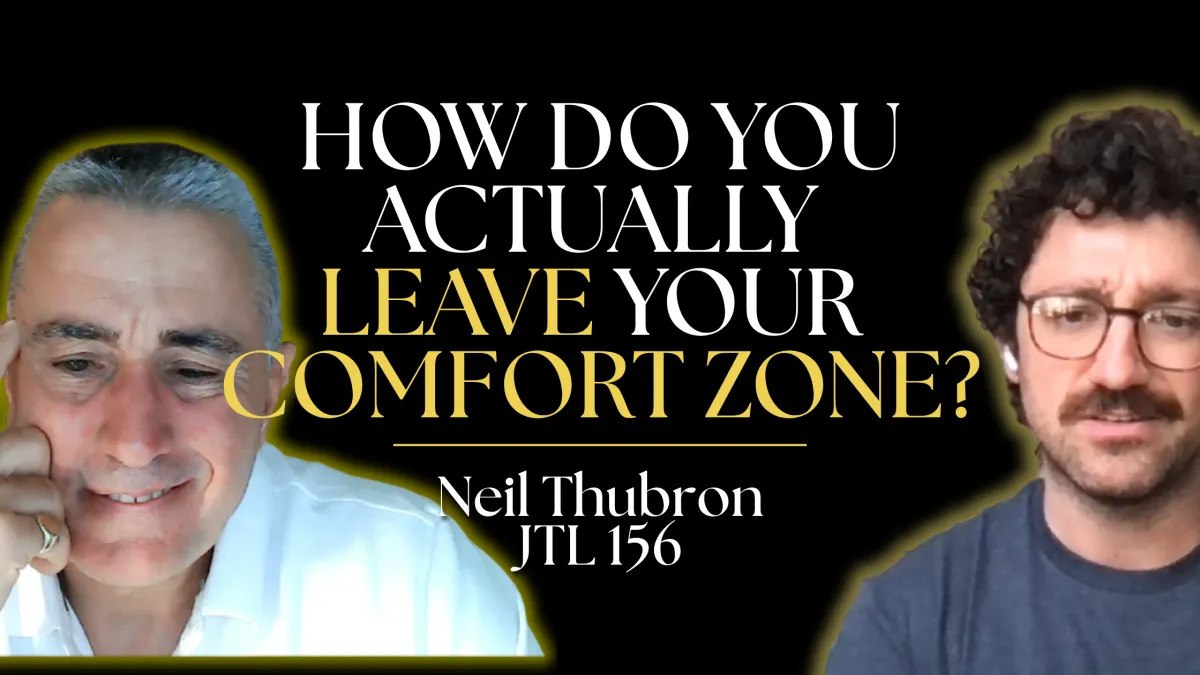
How to Actually Get Out of Your Comfort Zone
Want to hear the full conversation? Listen to the Journey To Legacy podcast Episode 156 with Neil Thubron for even more insights and stories from his remarkable entrepreneurial journey.
How to Actually Get Out of Your Comfort Zone
"Get out of your comfort zone" might be the most repeated advice in personal development, and the least useful. It names a destination and never shows you the door. Nobody tells you where the edge is, what to do when you reach it or what the first step actually looks like on a Tuesday morning.
Neil Thubron has a more practical version. He spent thirty years inside IBM before leaving to build Thubron Coaching and Consultancy, and at 50 he won the Yukon Arctic Ultra, a 300-mile race across frozen Canadian wilderness where only six of 45 starters finished. He did not get there by deciding to be braver. He got there using a method you can copy this week.
How do you know where your comfort zone actually ends?
You cannot leave a place you have not located. According to Neil, the edge announces itself in sentences you say out loud without noticing.
"I can't do that."
"I'm not that type of person."
"I'll do it when I have more money, more skills, more time."
Those are not descriptions of reality. They are boundary markers. Every one of them is a place where the discomfort arrived before the reasoning did, and your brain supplied a justification afterwards.
Here is the exercise. For the next seven days, write down every time you catch yourself saying one of those three sentences. Do not judge the entries. By Sunday you will have a map of your comfort zone's actual border, drawn in your own handwriting. Most people are surprised by how small the enclosure is and how quickly it fills a page.
Why "just get out of your comfort zone" is bad instruction
The advice fails because it points in a direction instead of naming a distance.
Psychologists have understood the shape of this since 1908. The Yerkes-Dodson law describes an inverted U between arousal and performance: performance climbs as arousal rises, peaks at an optimal point, then falls away when arousal becomes too high. Too little arousal produces boredom and underperformance. Too much produces anxiety and panic, and performance drops again. HealthlineYu-kai Chou
Your comfort zone is the flat left-hand side of that curve. The panic zone is the collapse on the right. The useful ground is a narrow band just past your edge, not as far from it as you can get. This is why "go big or go home" advice tends to produce neither. People aim for the far side of the curve, feel the collapse, then retreat further inside than where they started and conclude they are not built for it.
The instruction that works is not "get out". It is "go one step past the edge you just mapped, on a date you have already committed to".
Put a date on it before you feel ready
This is the mechanism, and it is the part self-help skips.
Neil's approach is to take the thing that scares you and put it in the calendar. Not the intention. The commitment. Enter the race. Book the course. Send the email that schedules the talk. Do it while the fear is still telling you that you are not ready, because you will never be ready in advance. Readiness is manufactured by the deadline, not before it.
The reason this works is that a vague intention has no forcing function. "I should get more comfortable speaking in public" generates nothing. A booked slot on 14 October generates preparation every day between now and then. You have converted a feeling into a logistics problem, and logistics problems are the kind your brain is actually good at solving.
Let the fear do the preparation
Once the date exists, fear stops being the obstacle and becomes the engine. Neil's framing is that fear is what makes you prepare properly. The people who go into hard things relaxed are the ones who get caught out.
The research backs the reframe. In studies published by the American Psychological Association, participants who told themselves "I am excited" before a high-pressure task scored an average of 80 percent on an objective performance measure. Those who told themselves they were calm scored 69 percent, and those who said they were anxious scored 53 percent. Anxiety and excitement are both high-arousal states, so relabelling one as the other is a much shorter journey than trying to calm down. Manner of speakingManner of speaking
That is the whole trick. You are not trying to remove the physical sensation before your first sales call or your first talk. The sensation is the fuel. You are only changing the label on it, and then letting it push you into the preparation that makes the thing go well.
What this looks like when someone actually does it
Neil's own list reads like a man who has run this loop repeatedly rather than one who was born fearless. A comedy course. An ocean race from Australia to China. The Marathon des Sables across the Sahara. Then, at 50, the Yukon Arctic Ultra in temperatures near minus 55, where he made the counterintuitive call to stop and sleep while faster runners pushed on and were evacuated with frostbite.
None of those started with a feeling of readiness. Each started with an entry form.
Your three steps this week
Map the edge. Seven days of writing down every "I can't", "I'm not that type of person" and "when I have more time". That list is your border.
Pick one and date it. Choose the smallest item that still makes your stomach turn. Book it, pay for it or tell someone it is happening. The commitment must be external to you.
Relabel and prepare. When the fear arrives, call it excitement out loud, then use the energy to prepare. The fear is doing its job.
You do not leave your comfort zone by deciding to. You leave it by putting something in the diary that your current self is not equipped for, and letting the weeks in between build the person who is.
Listen to the full conversation with Neil Thubron on Journey to Legacy, where he also breaks down why legacy is built in single conversations and how "I haven't created my legacy yet" becomes an excuse to stay stuck. Connect with Neil or download his book free at neilthubron.com.
TRANSCRIPTS:
WAYNE:
Picture this. It's February in the Canadian Arctic at minus fifty-five degrees Celsius. Forty-five ultramarathon runners started the Yukon Arctic Ultra, a three hundred-mile race across frozen wilderness, pulling a sled behind them. By the first night, the cold had devastated the competition. People were evacuated with frostbite, others straight up quit, and only six kept going.
My guest today was the winner of that three hundred-mile Arctic race, Neil Thubron. Now, Neil hasn't just been chasing marathon trophies all his life. He spent thirty years at IBM leading global sales teams. He served twelve years in the British Army Reserves, and over time, he realized something: extreme goals, both personally and professionally, aren't just about proving yourself.
They're about understanding something deeper. And now Neil has dedicated his time to actually teaching this to others. On the second afternoon of that race, after surviving that devastating first night, Neil looked out at a frozen lake and made a decision. He said to himself, "If I can get through these big, tough moments and find a way to keep going, I need to help others figure out how to do the same."
That decision defined the next twenty years of his life. Today, Neil is an executive coach who teaches that legacy isn't something you leave behind after you're gone. It's what you're building right now in every conversation and in every way you show up. In today's episode, we're gonna talk about stepping outside your comfort zone, how fear drives preparation, and how one conversation can ripple out and change someone's life years later.
So stick around for Neil Thubron on legacy, courage, and enabling others to become more than they ever imagined.
WAYNE:
Neil, well, again, thanks so much for being here. I, I do really, really appreciate it.
Neil:
No, it's absolute pleasure. Thank you for having me on, Wayne.
WAYNE:
Yeah. I mean, when I get to speak with high-level executives and executive coaches like you, often think, I'm like, "Well, why are they taking the time to come and speak with me?" it's, it's just such an honor really that I wanted to throw that out there. But kick us off, and people that aren't familiar with you, tell them a little bit about yourself and maybe why should they be listening to you today?
Neil:
So I- I'll, I'll do that in one second, but I just wanna make a comment about what you just said about why, why would someone come on? When you've got a podcast called Journey to Legacy, that is a really inspiring phrase to just pose a thought about, to, to be honest. You know, I... When I'm coaching people, I talk about...
And it, it unlocks someone's thinking when you mention the word legacy. If I'm working with someone in, in, in, in their job, and they're looking at their career and what they do next, like, and I ask a question like, "Well, what legacy would you like to leave?" It, it completely changes the conversation away from what they wanna do.
And so that's why I just wanted to share that with you, 'cause I think the title is, is brilliant. Uh, so a little bit about me, very, very briefly. You know, I've got a, a pretty varied background in the co- corporate world, uh, a 12 years in the British Army as well, which was in the Army reserves, and I've got an extreme sports, uh, extreme adventure type background too.
And I kind of bring those three things, and I'm at the intersection of where those three pieces come together with what I do today, because what I do today is all about helping others achieve what they want to achieve. So that's, that's a brief summary of who I am.
WAYNE:
Yeah, well, 12 years British Army, corporate CEO, extreme sports athlete. Neil, you've done some really, really impressive things. Really impressive. At the beginning of your career, did you think that you would be today? Did you imagine yourself being an executive coach?
Neil:
No. No, no, not at all. And, and you know, that's an interesting thought. And, and one of the things I w- I, when I'm working with people I get them to think about is when you're looking forward at what you wanna do next, at this big goal you wanna shoot for, the career, the, the new job you want to... the new business you want to set up.
When you look forward, it looks a bit overwhelming, and you have to take time to look backwards at where you've come from. You know, it, it's a bit like the analogy of, of climbing a mountain. When you're climbing a mountain, you're always looking up. You're looking to the top. You're looking to the goal. But if you just take a moment and look back, you see how far you've come up that mountain already.
And, and actually when you look back, the view's fantastic behind you. So that... When I started my career, I started as a typewriter engineer. So this is long before your time. There were things called typewriters that had... And I was a golf ball typewriter engineer. So that was these... IBM made these golf ball typewriters that came out long before printers.
So I was 19 years old when I started there. And when I started that role, when I looked at the executives in the organization like IBM, they were like gods. They were like these people who were on another planet. You know, another complete another level to where I... So I never looked at and thought, "That's my, my destination."
And then I never thought about leaving corporate life and going and do my own thing, which I've been doing for the last 11 years. It was just unheard of. In those days, you got into a corporate role, and you stayed in it until you retired. A- and so the answer is no, I never imagined that. And it's funny, when you get to each stage...
And I remember sitting down with a colleague of mine who came in the same time as me, doing the same job, and we both got to be senior executives at the same time. And we sat down having a drink one day and said, "You know, when we were typewriter engineers, did you ever imagine we would be here?" And, and the answer was no.
And the answer was, "But we are, and we're the same people. We've just got more experience. We've just developed our, our skills and our knowledge, and we've now taken on more responsibility. But it doesn't feel any different than when I was fixing typewriters 20 years ago," or however long ago it was. So I always think, you know, Steve Jobs talks about you can't join the dots forward, and I think that's so true.
What you can do is look for the next dot, though. And I think in a career that's really important is, what's my next growth? Uh, and it doesn't have to be upwards. You know, every- everyone thinks they have to move upwards to a leadership role or a man- It could be sideways. It c- could be just gaining some experience in, in doing the same job in another country or developing y- your skills even more in a particular role like sales or engineering or something.
But, but it's, you've gotta have, I think you have to have that next thing in mind 'cause that's how you grow. So yeah, that, the answer, the short answer to your question is no, I didn't imagine I'd be where I am now.
WAYNE:
Now, interesting is that, so I like your perspective here and the analogy of climbing a mountain, that it looks like this impossible feat looking forward, right? And also then when you look back, you really see how far you've come, right? And it almost is like a moti- motivating factor, and it is a great view to see how far you've come.
Neil:
It, it is.
WAYNE:
You know, you're... Sorry, so you're coa- you're coaching executives and you're talking to them about legacy even. I'm curious, it's like back in the day when you're an engineer on these typewriters, you thought this was impossible feat looking up this mountain. Like, what do you think could have been different at that point you had maybe worked with somebody like you that said, "Well, what do you want your legacy to look like?"
Neil:
Yeah. Wow. W- wow.
WAYNE:
Intentionally create it. How do you think it would've been different?
Neil:
Wow, I think that's a great question actually, 'cause whilst I had lots of mentors and, and, uh, and career supporters, things like that on the way, no one ever talked about legacy. No one. Uh, and would I have understood it as a 19, 20, 21-year-old? Probably not.
WAYNE:
Probably.
Neil:
You know, I... And I think legacy seems to come into the thinking, that word legacy, becomes more relevant as you're getting towards the end of your career, 'cause you're seeing the end of something.
Uh, and so that's one of the things I do see with people I coach, is from the 45 to 55-year bracket, that, that people are thinking about, "I've been doing this for 25, 30 years, and I want to leave a legacy when I leave." What, what they don't realize, and this is something I realize as well, is at every stage you're leaving a legacy.
Every person you manage, every customer you might deal with, everyone you support, at every stage you are leaving a legacy of what it was like working with you, for you, um, whatever it might be. Uh, so that's... I think that's really important to remember as well.
WAYNE:
No. Every stage you're leaving a legacy. Neil, that's, um... I know we're, we're sort of new friends here, but that is a pretty big mantra of my life, that, you know, legacy maybe takes effect when you die, but it's every day we're creating that legacy, right? And so like when, when you're working with these executives and you're having them think like, "What's the legacy that you wanna leave behind?" Is it fair for me to say that you're actually asking them, "What's the legacy that you want to create today?"
Neil:
Yes, it is 'cause they're not thinking about the legacy they've already created. They're thinking about the legacy in 12 months' time when they sell their business or when they, uh, retire or when they go and do their own thing. They wanna, uh... And by the way, what I find also interesting is some people use it as an excuse to stay where they are.
You know, "I haven't created my legacy yet. I haven't... You know, I've got two years' time I'll, I'll be comfortable with the legacy I'm leaving." And so sometimes they, they do use it as a bit of excuse, and that's where coaching comes in, is to kind of uncover those stories people are telling themselves.
WAYNE:
Yeah. Inter- so it's an excuse as in like a, "Well, I can't move on yet because I haven't done enough"?
Neil:
E- exactly. Yeah. Yeah. 'Cause there's this bit I need to finish. There's, I'm not ready to move on until this. But that's just a story people are telling themselves.
WAYNE:
Uh, okay. Usually I, I ask this question a little bit at the end, but I'm right? 'Cause we're talking so much about legacy, right? Def- define it for me and maybe give everybody an example for yourself. Like what's the legacy that you're working to create?
Neil:
So the way I would define legacy, and I'll give you an example. I'll give you a real example of, um, back in... When I-- we talked about South Africa earlier. When I was r- running a sales organization that was UK, Ireland, South Africa I had probably 60, 80 people working for me. And we, we had a, we had a great time.
We were very successful, great team. At the time, I got feedback that people liked working for me and, and it, and it was going well. Since then, 20 years after I left, probably, probably actually on that way, on the journey, probably 10 years, 15 years, 20 years, I will get a message from someone that was working for me then and say, "Uh, Neil, you know, I was sitting next to you at dinner this evening, uh, one evening, and we had a conversation, and that conversation changed the course of my life."
And I was like, "Wow." So... And that to me was... I, I didn't, I, you know, I can't even remember the conversation, but if, if it was that impactful on you, I've... That's, that's legacy 'cause legacy to me is just about how you make people feel. It's that, um, oh, what's the word? When you, you know, when a boat goes through the water and it has the wake behind it.
It's the wake you leave behind you and how it makes people feel. And you can... That can be both ways as well. You can leave a really negative legacy, you know, 'cause people hate working for you and they, they can't wait for you to leave, so the legacy is, you know, thank goodness they've gone. Or you leave a positive where, where you get these me- and I, I don- I get them reasonably regularly from people over the years who've...
And they, they're either, "We had this conversation, you gave me this bit of advice." Um, I had one of my coaching clients from, uh, a few years ago r- phone me up and said, "You know, you probably don't remember, but we had this conversation and you told me this." It was about stepping outside their comfort zone and doing something a little uncomfortable.
"And I did it, and now I've got my first CFO role." You know? And so that's... I think legacy is about how you make people feel and how you might help them achieve something they didn't think they could achieve before.
WAYNE:
How you make people feel, helping them achieve something they couldn't have. I love this, what you said, the wake that you leave behind you. 'Cause definitely you could have a negative legacy. You could go down being remembered as hurting people, as stepping on top of everybody, doing little to nothing positive for this world, right? But I really like that piece of how you make people feel and this wake you leave behind you.
Neil:
Yeah, yeah, yeah. I think that, that was just an image that came to mind then.
WAYNE:
Yeah, it's great. Okay, and so then describe for us what's the legacy that you're working to build, the one that you want to leave behind?
Neil:
So, I think I'm at a stage now in life... So I'm 61 years old now. I'm at a stage now in life where my purpose is my legacy. A- and I think I discovered my purpose probably 15, maybe 18 years ago, which is all about enabling people to achieve more in their business and personal life. So, so long as I'm- every day I'm enabling people to achieve more, and that could be anything from, um, from personal life and their relationships to helping them sell more, helping them become a better leader so that their team follow them more and they optimize their business.
It could be absolutely anything. So as long as I'm doing that, that's the legacy I wanna leave. I want people to say that because I was there, their life was different. And I think that's what I've been doing the last... So I don't think legacy is something in the future for me. I think I'm living the legacy that I want to live and lead, and it is all about, yeah, how can I impact most people in a positive way to help them achieve more?
WAYNE:
I really, I really love and appreciate that. The stories of how people reach out and say like, "Hey, you don't realize it, but I remember this and it had this huge impact on me," that's legacy.
Neil:
Mm-hmm.
WAYNE:
Is the proof of that it's being created every single day. And this is the realization, Neil, that I'm working on helping people realize that you're clearly doing the same, is that isn't something that we need to wait around for it to take effect, right?
Neil:
It is. We are creating it every day.
WAYNE:
So we, we are creating every day. Every interaction we have with people, we're creating it. We may not find out what that impact was or what that legacy was for several years, as I, as I said in those examples. Um, but, but, but if we're conscious of the fact that this isn't something that's gonna happen in the future, this is something that's hap- as you said, it's happening now.
Neil:
Every conversation, every interaction, every time you make someone feel a certain way, you're leaving a legacy. You're leaving that shadow of you.
WAYNE:
Nice, leaving that shadow of you. Really, really great. Love it. Well, Neil, I wanna, uh, backtrack a little bit. Let's rewind into your career, 'cause you've done some really amazing and interesting things.
Neil:
Yeah.
WAYNE:
What, what sticks out to you as a, let's say a defining moment or an instance that shifted s- perspective and trajectory in your life?
Neil:
Mm-hmm.
WAYNE:
To mind?
Neil:
So there've been a number of key moments where my trajectory was going along and then it shifted. One of them was before I was born, actually, 'cause I was adopted. And I didn't... I knew, I always knew I was adopted, but that, that definitely defined some of my behaviors, which I didn't know at the time, but I do know now. So that was something that, um, impacted me. Then I think, um, when I went into corporate life, and I became a manager very young in, in- 'cause, you know, there was some clear leadership skills and attributes I had that I wanted to use and, and were recognized quite early on.
So I was one of the youngest managers that IBM had, had had at the time. And then I joined the Army Reserves around that same... And that was a key, key moment because I didn't realize much about the military, about the Army, and I s- I got the opportunity to do some in- incredible physical challenges with some incredible people.
I got to go through Sandhurst and beca- you know, as a, as a British officer that gets commissioned by the Queen. And the... I learnt so much about myself. And, and at each moment it's about stepping outside your comfort zone. So there's... When I became a manager that's, I was massively outside my comfort zone because everyone I was managing was nearly twice my age.
When I be- was in the, stepped into the Army and was doing what I was doing with those guys, every time I, I was up in f- organizing events or I was in front of a t- of, uh, troops or I was having to make decisions, I was outside my comfort zone. But every time you step outside your comfort zone, you grow. And one of the maz- most defining moments for me though as to where I am now, pa- well, everything leads you to where you are now, but one key defining moment, I went to a, a Tony Robbins Unleash the Power Within event in 2007.
And I'd always been a Tony Robbins fan. I'd listened to a lot of his stuff, um, and, and Zig Ziglar and Jim Rohn and, you know, and, and this was when cassettes were out, not, you know, not iPads or iPods and stuff. Uh, and so I listened to all of that, that stuff, and I got to go and see him in 2007 in London.
And the reason that changed my trajectory in a number of areas was because I suddenly realized that the way I was approaching leadership in, in the business environment, in a sales environment was wrong and I needed to change the way I approached it. That was one thing that came out. But the second thing was I realized that actually I'm capable of so much more than I think I'm capable of.
And the third thing was I made a decision at that event that I was gonna find my natural parents.
WAYNE:
One.
Neil:
'Cause we went through a bit of a meditation and I, you know, I had a moment where I saw my, my birth, uh, in one of the sessions that Tony runs. So those were three key things that then changed what I then did over the next 20 years.
Um, so those are some of the key m- and then leaving IBM was a key moment, uh, after, like corporate life after 30 years, and that came about because of the Arctic race that I did back in 2015.
WAYNE:
Neil, I almost don't know where to start. Um, it's, it is great. You know where I think the best place to start is at we do need to realize, of course, that where we're sitting today is, um, I think is, is really meant to be, right? It's like everything that happens to us is key and is shifting us to where we are now, and where we are now is prepping us to where we need to go next. Let's start maybe something you said, right? Is that you said a big key is stepping outside of your comfort zone, right?
Neil:
Mm-hmm.
WAYNE:
Where you grow, right? A lot of people maybe realize this, but it's a comfort zone for a reason, right? Individuals that you work with, right, how are you helping them to get out of their comfort zones? And so how can our listeners actually start to take action to get out of their comfort zone, 'cause that is where they grow, that's where they're gonna achieve the next level in their life.
Neil:
And I think there's-- it's recognizing where the edge of your comfort zone is. And, and the way you recognize that are through thoughts and words that you say to yourself. So if you think, "I can't do that," when you're, when you're asked to speak on stage, when you're asked to take over a big team, when you're asked to, or you, you, you are asked to run a marathon or go...
When you think, "I can't," you know you're at the boundaries of your comfort zone. When you avoid doing things as well. You, you say, "Yeah, I'm, I'm, I'm, I'm not that..." The story you usually tell yourself, "I'm not that type of person. You know, that's not something that I would do." As soon as you start telling yourself those, those stories, and I see this with, with people I coach, it's normally they don't realize they're doing it, and this is where coaching helps 'cause we're, we're listening out for the things that aren't said.
And, uh, and you can tell when someone, they say something like, um, "Yeah, yeah, of course I'll go and do that," and you know their body language, the way they've said it, they're not gonna go and do it. So that's where you, you, you, you challenge them. Um, but I think the, yeah, the key is- if you hear yourself saying, "I can't do that," or, "I'll do that, you know, in a year's time. I'll do that when I've got some skills in this area. I'll do that when I've got enough money," or whatever it might be, those are all excuses, and those are good examples of, right, I need to say yes to this. And s- you, you know that, uh, movie Yes Man with Jim Carrey?
WAYNE:
Yeah.
Neil:
Uh, honestly, that's, that's a brilliant example of if you think you're just about to say no, say yes, and you know you're stepping outside your comfort zone, within reason.
WAYNE:
Uh, within reason. Within reason, absolutely. Okay, great. This is an awesome step and for people to realize is first understanding and realizing where your comfort zone is. And these are really great actual things. Everybody, go rewind a minute, two minutes here, right? And listen through what Neil just said again. 'Cause when you're thinking, "Oh, I can't do that," that's the boundary of your comfort zone, right? Or it's like a, "Ah, that's not who I am. I'm not the type of person that does that." Again, you're understanding where this boundary of your comfort zone lives, and this is what's prepping you now to go and be a yes man and be like, "Well, why not? Okay, I was about to say no. I was about to have this limiting belief. Let me push through." And so is there anything that you then tell some of your clients or individuals of then, well, how to push through, right? It's because, again, this is my comfort zone for a reason. I have this limiting belief of I can't. How do I get past it?
Neil:
So I can tell you what I've done, uh, and what I've, you know, what, where I've experienced it. So I, I'll give you an example from a couple of years ago, actually. 'Cause I'd done, you know, these big extreme running events and all in the deserts, the mountains, the, the Arctic. And, and every single time I entered one of those, I was scared to death about doing it. And I was fearful. I was, you know, I was fearful of failure.
I was fearful of w- the, the pain it was, what it was gonna be like being out there doing it. I remember when I entered the Marathon des Sables, which was back in 2007, in the, um, which is a, is a, it's um, a run across the Sahara Desert for six days, carrying all your kit. And I was watching it on TV with my wife on a Saturday morning, and I'd seen it a few times, and I'd seen celebrities doing it, you know, athlete celebrities doing it.
And, and I said to her, "You know what? That, that looks really exciting." And I'd done a few Ironmans and marathons and things, so I was pretty fit, but I hadn't done anything as extreme as that. And this is where it's great having someone who believes in you more than you believe in yourself. And she just said, "Well, well then enter it. Why don't you go do it?" And I couldn't think of a reason why not, so I did. But then the great thing about stepping outside your comfort zone was the fear drives you to then prepare really well, to learn what you need to know. And so that's one of the things I would... I, I've learned is... So this would be my advice to anyone who sees something that they feel they can't do or be fearful.
The first thing is go put it in the calendar. Make, get it in the calendar so that you- you've, you've booked it, you know you're gonna do it, and whatever that might be. Um, one of the fears I, I, you know, I've done a lot of public speaking. I was a pr- a professional public speaker. I've done Toastmasters. I've won Toastmaster events. But one of the things I never did because I was fearful of it was comedy. And I went and booked my... In fact, it was my wife again. She, um, she knew this was a limiting belief of mine, that, uh, there was a fear of going and doing comedy and f- as a standup comedian. And for, for a birthday present, she booked me on a comedy course, and that was pretty scary.
Uh, and I... But it was in the diary. I had to commit to it. And we-- to pass that course, we had to do a five-minute sketch in a pub in West London on a Sunday night with a, you know, bunch of people who'd been drinking for several hours. That was pretty frightening. So I guess, uh, identify that fear, then get it in the calendar, and then start planning and get moving towards it.
WAYNE:
Nice. Identify the fear. Action, yeah. Make it real, tangible. Put it in the calendar. H- having somebody that's gonna support you and hold you accountable also is amazing. Such a reason, everybody, to... If you don't have an amazing partner in your life like that, right, a reason to look towards coaching, to look towards mentorship, right?
Neil:
Yes.
WAYNE:
You're not at the position to be able to pay for one, like, go find somebody that you just look up to that's in a managerial position, right? Those can be mentors also, right? Those can be coaches to help hold you accountable for things. Really, really great. And fear drives you to prepare. Neil, that's what you said as well.
Neil:
Yeah, and it does. I mean, I've... Everything I've done where I'm fearful of doing it, uh, and I did a, a, an ocean race recently. So two years ago, I raced from Australia to China, so 5,500 miles on, in an ocean racing yacht, um, in a, in a, in a race. Uh, and when I entered it, it was one of those... Again, it was one of those moments.
I was watching it on Instagram or on YouTube or something. I thought... 'Cause I do a lot of sailing, but I'd never done anything like that, and I said to, to a- to my wife, Anna, I said, "Look, you know, that, that's, that scares me." And, uh, 'cause being... You watch those boats, and the waves coming over them, the living at 45 degrees.
The, um, the, the tensions. You know, just the, the, the power of the sea and the wind and the... It's just, it... And, and it is raw as anything, 'cause you are thousands of miles away from any help, so you are on your own in th- this small 70-foot boat in a hostile o- ocean, a hostile environment. But again, I, it's two years before I did it, and just made me focus on preparing for it.
By the way, the great thing about doing these things that fear, that you, you're scared of and then achieving it is there is no better feeling than when you've done that. You've stepped outside your comfort zone. You've, um, achieved these ama- amazing fear... goals. You've had to go through a lot of hardship to get there, but when you get there, that is... It's like a drug, that feeling.
WAYNE:
Really unbelievable. Really, really unbelievable. Neil, um, so sad that we don't have unlimited time here. So let me steer a little bit towards something that's still very actionable for everybody that's, that's listening. Um, you have a book that I wanna talk about, then let's go towards a little bit of this story that the, uh, I guess the book is based around. And, uh, and then you can go into the framework also. And so you, uh, competed in a different race, right? It was a 300-mile ultramarathon through the Arctic, one of the toughest ultramarathons in the entire world that exists. Tell us a little bit, what, what was this race? Why, why were you crazy enough to even sign up for it?
Neil:
Okay, so the race is called the Yukon Arctic Ultra. So it's in the northwest territories of Canada, just below the Arctic Circle. So you start just below the Arctic Circle in February. Uh, the start line, it was -35 degrees centigrade, and it, it got... Over the race, it got down to -55 degrees centigrade, so it's very, very cold.
Uh, and I got, I got into it in a bizarre way, actually, because I'd, I'd done desert runs, I'd done some mountain runs, some big 100-mile mountain runs, and I was... 'Cause I organize ultra events as well, and someone was taking part in one of the events we organize, and they were taking part in the event to the... it was an 84-mile, three-day event, and they were pulling tires behind them. And I said, "So..." You know, attached to some string, and then, and then attached to the tire. I said, "What are you doing?" They said, "Well, we're training for the Yukon Arctic Ultra." And so they were simulating pulling a sledge behind them by pulling tires.
And I thought, "That sounds interesting." So when I got back that Sunday evening, I had a little Google, had a look, and I'd actually had a vision board. And on my... You know, I have a vision board now as well. I've, I've always had vision boards. And I had, on my vision board was a picture of a person walking through the Arctic with a sled behind them.
So it's always been in my mind that I wanted to do it, but when I looked at it, I thought, "You know, this is insane." 300 miles pr- pretty much nonstop, apart from, you know, the odd sleep, bit of sleep here and there. In those temperatures, you know, that scares the hell out of me. And, and 'cause I had that belief that, well, if it scares you, you gotta go do it, that was how I ended up doing it.
And, uh, so the event starts on a Sunday morning, and I did it in 6 days and 19 hours. And I, I was the first Brit to win that event as well, so I was the first British person to cross the line first.
WAYNE:
Wow.
Neil:
But it was extreme. That, that particular year, the first night got down to minus 55 degrees centigrade.
Now, I didn't know that at the time. I didn't realize that it was that cold because I, you know, y- I've got... I'm not carrying a thermometer with me or anything. But I knew it was hostile because I, uh, I hadn't seen anyone. There was 45, 46 people started the race, and during that first night, I was on my own.
You know, it's totally silent in those conditions. You just keep going forward with your, your walking forward, making your way through the snow. But, like, it was getting so hard and so... I was so tired, and which, which I shouldn't have been at that point. I was probably 40 miles in. I should've been absolutely fine.
But so I had to make a decision to stop, and I decided, which is not a simple decision in those temperatures. But I made a decision to put my tent up, get my sleeping bag out, and get a couple of hours sleep, and then I kept going to the 50-mile checkpoint. Uh, and when I got there, I realized that something had happened that night that I wasn't aware of, and after... the whole field had been devastated by the cold. We'd had people evacuated off to hospital with frostbite on their hands and feet. We'd had people who were just terrified of the cold and how hostile it was and just stopped and gave up. Um, so after that first night, there were only six of us still going. So, you know, the field was devastated.
And it was after that night, I was going into the second afternoon, and it was a beautiful sunny afternoon. The sun was kind of setting on my left-hand side as I was going up this trail, and there was a sparkling, shiny frozen lake to my right. And I just decided, look, if I can get through these big moments and these big challenges and keep going, I need to help others.
And, and that was why I wrote the book, was to help other people achieve their big goals.
WAYNE:
Wow. I mean, so what, minus 30, 50 degrees is unfathomable for most people. I mean, again, this race is up in the Arctic Circle. Does it take place in Canada, up like the...
Neil:
Yeah, it's the northwest part of Canada, just below the Arctic Circle it starts, and it finishes above the Arctic Circle.
WAYNE:
Curious, so that night when you decided to rest, do you think that was for some reason you being able to get warmer or take a break that was able to get you through when so many other people had to be evacuated, gave up? Like, what's the difference? Why weren't you one of those that had to give up, had to call it quits?
Neil:
So, uh, this is a really key point that I try and work with my coaching clients on, and I speak about as well, is when things are not going the way you thought they were gonna go, you have to control the controllables. Focus on what's in your control right now. And I knew that 'cause I didn't know how far I'd gone.
I just knew that this 50-mile aid station hadn't appeared when I expected it to appear. And I gave it an hour and it still hadn't appeared. So I, okay, if I keep going, I'm gonna get myself in trouble here because I'm just getting tireder and tireder and, and, you know, physically and, and s- you know, mentally.
So the most sensible thing I can do that I can control is to stop and get some sleep. And it was probably... It was a hard decision to make 'cause putting up a tent in those conditions and getting a sleeping bag out, you've gotta be really fast at doing it because otherwise you've got a good chance of getting frostbite.
So it was a big decision, but it was based on, it was something I could control and do, and I knew that I needed to focus on survival, you know, and making sure I made some good decisions. 'Cause I know how important rest is when you're exhausted, and I know that from my time in the military and all the other events I've done.
So, um, that was why I decided to do it, and it was a smart decision 'cause it meant that I was okay to keep going, whereas other people were just completely wiped out.
WAYNE:
Wow. Wow. Yeah. Control what you can.
Neil:
Yeah.
WAYNE:
When times get the toughest, focus on that. What can you control right here, right now?
Neil:
Yeah, absolutely. Absolutely key.
WAYNE:
Hmm. You know, what's... Tell everybody, what's the title of your book? We'll be sure to link to it down below as well.
Neil:
Yeah, so it's called You Can Achieve Any Big Goal Using the 7P Formula for Success, and the 7P formula was literally just the structure and process I developed in my head over the next five days while I was on my own out doing that event.
WAYNE:
Oh, amazing. Okay. Everyone link down below. Over here I'm, like, scratching my brain. I'm like, do we have time to go through these seven Ps right now? And I think I wanna leave it as a teaser. And Neil, I think I wanna invite you back and have everybody go check out the book, go check out your website down below. Um, but really amazing. It's so great to talk about legacy and, uh, and then when you get to tie it into all your experience from the British Army, from actual business, extreme sports, uh, is just really, really unbelievable. Um, love it. Neil, I always like to ask near the end as well, like, is there anything so far maybe that I haven't asked you that, like, you think I should have, right? That's sort of top of mind that you wanna talk about?
Neil:
It's a great question, and let me ask you a question actually, if that's okay.
WAYNE:
Yeah, please.
Neil:
'Cause I don't hear many people talk about legacy. You know, I have to bring it up when I'm talking to people about legacy. And I'm curious, you know, in all the discussions you've had, in all the podcasts you've, you've interviewed, with people you've interviewed, is there a moment, or is there a type of person... What, how does it get to that point where people start thinking legacy? I guess that's probably the question I've got in my head.
WAYNE:
Yeah. Yeah, it's interesting. I mean, so what you mentioned earlier, um, when people start to get a little bit older, right, I think they start to then realize as well that they're like, "Okay, I might not live forever. Let me be more purposeful about a legacy that will last after I'm gone." Or a lot of times, and I'm curious to you as well, like maybe when you first realized it, is other individuals that I talk to that went through life-threatening incidents,
Neil:
Mm-hmm. Okay.
WAYNE:
Fast-forwards it. For myself, I went through, uh, an incident where I fell off of a building, had to be helicopter airlifted. Uh, I broke 17 bones, woke up with a neck brace and tubes down my throat, and, and that's when I realized, like, before it happened, it was a normal day. Uh, and I realized that, like, any single day can truly be our last.
Um, and I mean, you look at people that are in car accidents that die every day where somebody crashes into them,
Neil:
Mm-hmm.
WAYNE:
At fault. It was a normal day. Or an airplane crashes into a building when you're just sitting there. It's a normal day. And so let's today start to actually take action, right? Because it could be our last.
Neil:
Yeah, that's a gr- uh, okay, that makes a lot of sense, that legacy comes into people's minds when they realize their mortality,
WAYNE:
Mm-hmm.
Neil:
Uh, whether that's early on or whether it's later in life. And it's like that phrase, "Live every day as if it's your last." Live every day as if you're creating your legacy now, would be another way of putting it. But yeah, no, that's... Thank you for sharing that.
WAYNE:
Yeah. Neil, I appreciate it. Live every day as if you're creating your legacy now because you are, right? You truly are. Five years from now, somebody's gonna call you and say, "Hey, you didn't realize it, but the way that you treated me, the way that you made me feel changed my entire life."
[Short crosstalk here in the source: a stray non-English fragment and a fragmented handoff between "Neil," and "you." / "my friend" — sense reconstructed below.]
Neil:
And they might not ring you, but you have changed their life. Or you might have changed their life, yeah.
WAYNE:
Absolutely. Neil, I appreciate it. For everybody that wants to learn more about you, where's the best place for them to go?
Neil:
Yeah, so two places. My surname is quite unusual, Thubron. So if you look for me on LinkedIn, Neil Thubron, you'll find me there. Please go connect with me and message me. I love to hear from people. And my website is neilthubron.com, so that's another place you can find out about what I do and connect with me as well. And, and actually, you can download a free copy of the book on there as well.
WAYNE:
So we'll link to it down below. Neil, thank you, my friend.
Neil:
Pleasure, Wayne. Great to see you.
WAYNE:
And that's a wrap. Thanks for tuning in today, everyone. Neil said legacy is all about how you make people feel. It's the wake you leave behind you after you're gone. And that right there is the reason that people still reach out to Neil years later saying that one conversation, which he likely doesn't even remember, changed their direction of life forever.
That's legacy happening right here, right now. Three quick takeaways for you from today's episode. One, legacy isn't something you leave behind. It's what you're creating today. Every conversation, every interaction, that's your legacy being written right now. You don't have to wait to create it. Two, your comfort zone is your compass. When you hear yourself say, "Oh, I can't do that," or, "No, I'm not that type of person," you've found the edge of your comfort zone, and that's where growth lies. That's exactly where you need to go. And three, focus on controlling what you can control and put everything else in the back seat. When things get chaotic, focus on what's in your control right now. That one mindset is what changed everything for Neil in the Arctic, and it'll change everything for you too.
If you want to connect with Neil, head to neilthubron.com or find him on LinkedIn to learn more about his coaching and to grab his book on the 7P formula. Thanks for tuning in today, everybody. My name's Wayne Veldsman, and we'll see you next week on Journey to Legacy.


