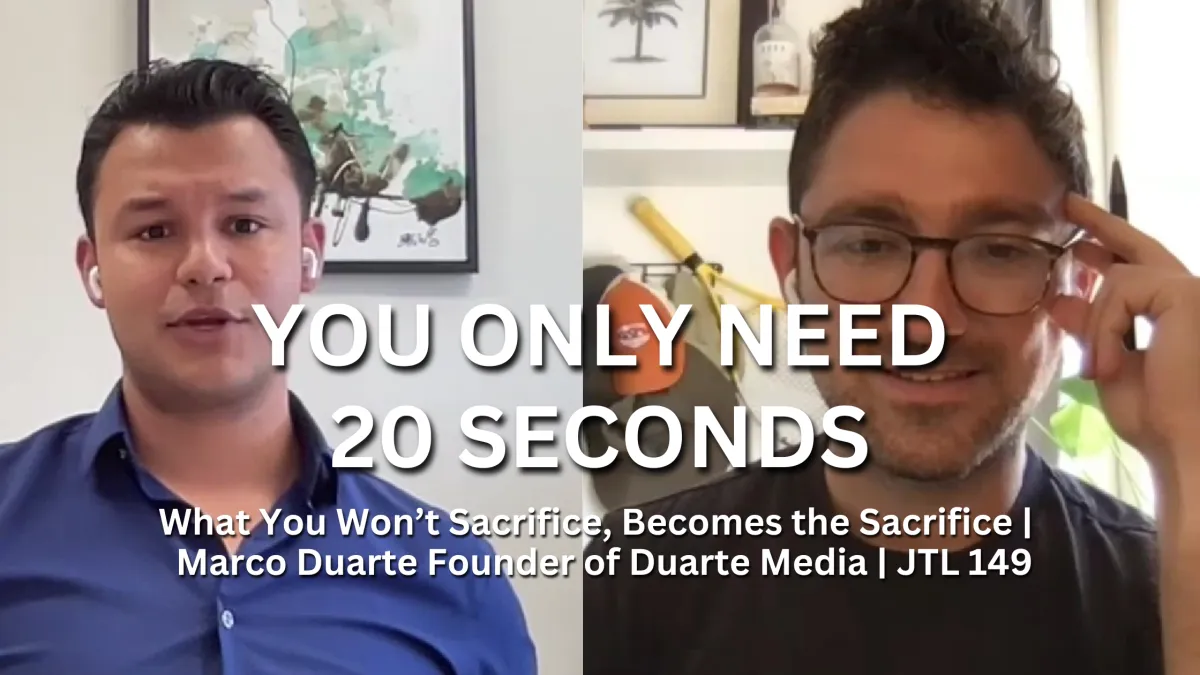
20 Seconds of Courage: The One Idea That Helps Entrepreneurs Stop Overthinking and Start Moving
Want to hear the full conversation? Listen to the Journey To Legacy podcast Episode 149 with Marco Duarte for even more insights and stories from his remarkable entrepreneurial journey.
20 Seconds of Courage: The One Idea That Helps Entrepreneurs Stop Overthinking and Start Moving
There's a moment most entrepreneurs know too well. You have the idea, the opportunity is right in front of you, and your brain - beautifully, cruelly - decides it's the perfect time to run seventeen different worst-case scenarios. You don't move. The moment passes. Later, you wonder why.
Marco Duarte has a name for what you need in that moment: 20 seconds of courage.
Marco is a Guatemalan-born entrepreneur who left home at 18 on a full athletic scholarship, competed as a swimmer across three US universities, and eventually made the bold - some might say slightly unhinged - decision to move to South Africa to build a business from scratch. He now runs Duarte Media, a performance marketing agency in Cape Town helping small and medium businesses get measurable results from Google and Meta ads.
He shared the 20-seconds idea during his conversation on Journey to Legacy. And where did he pick it up? A movie he genuinely couldn't stand.
The Movie Nobody Talks About
Most people credit their turning-point ideas to bestselling books or legendary mentors. Marco credits a film he describes as "the most boring movie ever" - one he sat through mostly out of obligation. But in it, a father turns to his hesitant son and says something that Marco has carried ever since:
"You only need 20 seconds of courage. That's all you need in life."
20 seconds to ask for the promotion. 20 seconds to make the sales call. 20 seconds to press record on your first video ad. 20 seconds to send the pitch, launch the page, walk up to the person, or book the flight.
The philosophy isn't that things won't be scary. It's that the scariest part - the threshold - only lasts a moment. Once you're through it, you're in motion. And motion, as any entrepreneur will tell you, changes everything.
Why We Suffer More in Our Heads
Marco pairs this idea with something else worth sitting with: we suffer more in our imagination than we do in real life. The fear of starting, of rejection, of looking foolish - it's almost always worse in anticipation than in reality. The awkward video gets fewer cringe-worthy views than you imagined. The pitch goes better than you rehearsed for. The country you moved to starts to feel like home.
For entrepreneurs specifically, this pattern is expensive. Every hour spent paralysed in overthinking is an hour not spent building, testing, learning, or connecting. The 20-second framework is a circuit breaker. It doesn't demand that you stop being scared. It just asks you to act before the fear gets comfortable.
The Window That Closes
Marco has personal proof of what happens when you don't act. At 18, he missed the qualifying cut for the Youth Olympic Games - not because of talent, but because he got distracted. He also once received an email introducing him to what's now one of South Africa's most popular coffee chains. He ignored it out of imposter syndrome. Two months later, they hired an entire marketing team.
"That opportunity might be gone forever," he says. "Anyone listening to this - you probably have an opportunity right now. That window might close."
This isn't meant to create anxiety. It's meant to create urgency - the productive kind that gets things off the mental shelf and into the world.
How This Applies to Your Marketing (Yes, Really)
One of the most practical places Marco sees 20 seconds of courage fail people is in front of a camera. His number-one piece of advice for entrepreneurs who can't yet afford a full marketing team? Get comfortable talking to the lens.
Not perfectly. Not with a production crew. Just authentically. Because in performance marketing - running ads on Meta and Google - the single greatest competitive advantage a small business owner has over a large competitor is their genuine personality. A real human being introducing themselves and speaking with honesty will outperform a polished corporate ad more often than not.
The connection you build becomes a relationship. The relationship becomes a collaboration. That's Marco's formula - and it starts with 20 seconds of courage to press record for the first time.
Marco Duarte crossed oceans and left behind everything familiar to build a life worth being proud of. He didn't do it with a perfect plan. He did it - as he'd tell you - one 20-second burst at a time.
Whatever you've been putting off, whatever window you're staring at and not walking through - maybe it only needs 20 seconds.
→ Listen to Marco's full conversation on Journey to Legacy [LINK] | More episodes and resources at journeytolegacy.org
Transcript from interview:
Wayne: Welcome back to Journey to Legacy, the show where purpose-driven entrepreneurs share the real story behind the impact they're building. I'm your host Wayne Veldsman. My guest today is Marco Duarte, a Guatemalan-born entrepreneur who competed as a student athlete across three US universities, built a business from zero in a foreign country, and now runs Duarte Media — a performance marketing agency helping small and medium businesses get real, measurable results from Google and Meta ads, located right here in South Africa. In this conversation, Marco gets into why authenticity in front of a camera beats any ad budget, what it truly costs to chase your dreams across continents, and a single idea from a movie he once hated that completely changed how he approaches fear. Welcome to the show, Marco Duarte.
Marco: This is my good luck pen. Yeah, it's the shitty one, but it's good. When I grab this pen it ties into a lot of what your podcast stands for — legacy. The main reason why this very cheap, crappy pen that I don't even like the way it writes is my good luck pen, is because it ties to my roots, to where I'm from. It gives this amount of energy. You cannot create energy — you receive it. I receive it from Guatemala. Guatemala is always in me. I'm always in Guatemala. When I grab this, I carry the small country, big city dreams kind of thing.
Wayne: That, my friend, is the one. Family and heritage are super important to you. Why don't you kick us off — tell everybody a little bit about yourself.
Marco: My name is Marco Cab Duarte, born and raised in Guatemala — small country underneath Mexico. I was born and raised there for 18 years, and when I was 18 I had the privilege of going to the US to be a student athlete. I lived in Florida, West Virginia, and Michigan. Countless lessons. I love the US with a deep passion. Then in June of 2024 I had the opportunity to move to South Africa. I moved to a place called Pietermaritzburg — a lot of people call it the Hole — then I lived in Durban for a little bit until I moved to Cape Town, which is now home. South Africa has been home for almost two years. It was easy to feel at home here, which I'm very grateful for. It was similar to the US in some ways — though going from a small country in Guatemala to the US is super hard to adapt to. You understand the culture differently. But you know what I fell in love with first? The size of the burgers in the US.
Wayne: Ha! Tell us a little bit about Duarte Media — what are you all working on?
Marco: Duarte Media is a performance marketing agency. We help small to medium sized businesses maximise the results they get on Google Ads, and Facebook and Instagram ads. We also help them get found on Google My Business, and now we also help businesses show up when someone searches on ChatGPT. That's the thing I do. I'm a marketer. I used to import coffee from Guatemala — not doing it anymore, too much paperwork — but I'm still helping the family import coffee from Guatemala to South Africa. The main thing now is the performance marketing agency. Duarte Media has been alive for around three and a half years. We're going to hit our fourth year this one. After three years, the majority of small businesses have died — so we're very happy.
Wayne: There have been a couple of pivots, but you're super focused on the performance marketing agency now. For everybody listening who's not really aware — define what you mean by performance marketing.
Marco: I'll do it in the simplest form. There is a difference between creating organic content — posting on Instagram or LinkedIn — and performance marketing. With organic content, it takes a lot of time, a lot of effort, a lot of hours. And the hardest part, in my opinion, is that you don't really know if it's working. You cannot track it. Performance marketing is the other way around. It puts us — the marketers — on the spotlight. We cannot shy away by saying 'we're building the brand' because we can track every single thing that is happening. If your business wants to advertise on Google and be one of the sponsored results, you grab your budget, you pay Google a certain amount per keyword, and it shows at the top of the search page. You can track how many people clicked, subscribed, called — whatever CTA you want. And then you can see, based on the amount of leads you generated this month, how much did you get back based on the budget you put in? That's why I like performance marketing. At the end of the month, I'm able to sit down with my clients and really see: did I do a good job, or did I not?
Wayne: Much more about the numbers and the fact that you can directly track performance versus organic posting. What's the difference between companies that are just using ads and companies that are actually growing from ads?
Marco: The difference is the feedback loop. Someone that grows with paid media is able to see which type of customers they want in the future. I work a lot in the travel and hospitality industry. I have a client running fishing safaris from Namibia to Angola — he wants to track every KPI, every booking. After four months working together, we can see exactly who his ideal customer is and who he doesn't want — the ones that go off on their own in the middle of the night and create problems versus the ones who respect the group, have experience, and add to the community. That understanding lets you enjoy doing business more. You attract more of the right customers and fewer of the wrong ones.
Wayne: So that feedback loop — using the data you get from the ads to make smarter decisions about who you're targeting — is the key differentiator?
Marco: Exactly. You can really enjoy business more because you understand the customers you want more of and the ones you want less of.
Wayne: Let's give some actionable advice. We have a huge audience of new entrepreneurs who can't afford an outside team right now. They have some money to put into ads, but not money to pay someone like you. What should they be doing differently to see results rather than just giving Mark Zuckerberg another boat?
Marco: Ha! The number one thing for a new guy in the industry trying to get leads — get comfortable speaking in front of a camera. Because if budget is your problem, if you don't have a big name yet, the only thing you have is time. That is your most valuable resource. Get very comfortable talking in front of the camera, because if your budget is low, if your processes aren't perfect, if you have holes in your business — a connection you make in front of a camera will bring people to you instead of your competitor, just because of that connection. A connection that turns into a relationship that turns into a collaboration. Start a Meta ads campaign. Start cheaply — don't put a big budget on it. Introduce yourself to the camera. Introduce what you do. Be as authentic as possible.
Wayne: Start with getting comfortable on camera in order to build a connection, which then transitions into a relationship, and eventually a collaboration — clients, referral partners. Love that. Where did you originally learn to connect with others? Your personality is very outgoing, very infectious. How did you learn to relate to people this way?
Marco: I think it's the amount of coffee I drink. But honestly — I'm actually an introvert. It is hard for me to put myself out there. The way I learned it was getting thrown into the deep end. You can learn how to swim online, you can watch videos, but unless you're in the pool swimming, you don't know how it feels. When I went to the US I knew no one. I was shy. I could barely speak English. You have to learn how to make friends, make connections, raise your hand and ask the professor a question. If you want to connect with someone, you need 20 seconds of courage and just do the thing. If I can make someone breathe a little easier that day because they had a laugh with me — even at an inappropriate joke — I won the day.
Wayne: You said 20 seconds of courage. What is that? Tell me more.
Marco: I learned English by watching Friends, The Office, How I Met Your Mother, The Godfather — all those. And there was one movie I hated. The most boring movie ever. But it had one quote I still use to this day. I believe it's 'We Bought a Zoo' — the one with Matt Damon. He loses his wife and then purchases this property and gets a bunch of animals. He says to his son, when the son wants to ask a girl out but is too scared — he tells the story of how he met his own wife. And he says: 'You only need 20 seconds of courage. That's all you need in life.' That's all you need to ask for a promotion. To go for a job interview. To start a business. To find the love of your life. To seize new opportunities. 20 seconds of courage — that's all it takes, and it can change your life completely. I've incorporated that into my lifestyle 24/7. Even before logging in today — 20 seconds of courage.
Wayne: I'm kind of surprised I've never heard of that movie. But if you're scared to take the leap, to do something new, to get uncomfortable — all you need is 20 seconds of courage to get you over that threshold. To walk up to that girl, to start the business, to make the sales call. And what I heard this past week is that we often suffer more in our imagination than we do in real life. We're worried about what might happen. But most of the time it's not going to be nearly as bad on the other side as what we're making it out to be in our heads.
Marco: I love that. It's just a different way of saying the same thing — stop overthinking. Stop being in your brain. Just 20 seconds. I'm definitely going to steal that one from you, Wayne.
Wayne: So Marco — you grew up in Guatemala, 18 years of your life. You decided to go to the US, study there, become a student athlete. And then you decided to come to South Africa. You keep putting yourself in difficult situations. Why not just stay in Guatemala? Why not stay in the US when things felt safe? Why do you keep doing this?
Marco: In Guatemala, I felt I was going to explode. I felt too small. It's an amazing culture — the food, the family, the vibes, everything is incredible. But it's very, very small and I always wanted to see the world. I was lucky to see the world through swimming. I went to Aruba, Colombia, the US for pro swim series. I saw how big the world was. And I wanted to learn from people who were in a better position than me, had more experience, had more culture. I think that growing your brain by starting from zero is one of the best things about being young. You can say goodbye to the friends and family, say goodbye to the job you don't like, start from zero — and still make it. Just drink your coffee, make good connections, keep moving forward.
Wayne: Life doesn't wait — be sure to live it fully where you are. Tell us more about that.
Marco: I messed up when I was 18. I had the opportunity to go to the Youth Olympic Games in Argentina in 2018 — swimming my whole life, and that was a birthday gift turning 18. I got distracted. I didn't make the cut. I was heartbroken for three months. I thought my life had ended. But I learned that opportunities sometimes come once in a lifetime, or twice, or three times if you're very lucky. But if you don't get 20 seconds of courage and take that opportunity — it might be gone forever. Anyone listening to this — you probably have an opportunity right now to start that new venture. That window might close in the future.
Wayne: Life doesn't wait. Seize it while you can. We only have a certain number of opportunities. And that sounds like a big reason you decided to leave Guatemala and even come to South Africa.
Marco: Exactly. And opportunities do come back — I'm not saying if you didn't take one six months ago you should give up. But there was one opportunity I missed in South Africa that I'll never forget. One of the most popular coffee shops in South Africa now reached out when I was just starting. They wanted a marketer. I ignored the email — pure imposter syndrome. Two months later, they hired an entire marketing team. So when opportunities come, grab them. Don't let them go.
Wayne: Is being so far away from your family one of the biggest challenges of chasing your dreams? And do you think people underestimate the emotional cost that comes with it?
Marco: Chasing your dreams means sacrificing everything. Because what you're not willing to sacrifice becomes the sacrifice. If I'm not willing to sacrifice living in Guatemala and breaking bread with my family to chase my dreams, then the dream becomes the sacrifice. I believe in winning in all areas — family, partner, business, fitness, faith. But there are some things you have to give up. My family — they have two ways to make money: either you're a farmer or you're a doctor. I was the first person who was an athlete. To chase my dreams, the rest of my family said 'Marco, you don't need to go to the US — you have everything here.' But I didn't want the perfect life. I wanted to figure it out by myself. Saying goodbye to my family was one of the hardest things. We eat breakfast for three hours, get up, eat lunch for three more hours, have dinner for three more hours — that's how we work. We spend a lot of time together. Saying goodbye to all of that is incredibly hard. The emotional toll is real. It's not incredible in a good way — it's hard. But that comes with chasing your dreams. And don't pay attention to Instagram gurus posting Lambos. Check the real winners — Tom Brady, Michael Phelps, what did they sacrifice to get where they got?
Wayne: The emotional cost of chasing big dreams is very real. But what you're saying is — you're always going to have to sacrifice something. It's up to you to decide: do you sacrifice the old comfortable life, or do you sacrifice your dreams? Pick one.
Marco: Yes. And I'll add — there's also a false dichotomy in what I'm saying. You don't have to say goodbye to your mother and father and move to an entirely different country. You can start a business from your own home. You can do those things. I did it because I wanted to travel the world while building my life. Life is always in a grey area — there's no always black and white. It depends on the person and what you want.
Wayne: Every choice you make is the right one in the moment — you're making it based on the information you have at hand. And no matter what, you learn from it. Maybe a month, a year, 10 years from now you decide that choice no longer serves you. So you make another one. Pivot.
Marco: I love that. I love that. You don't have to sacrifice your family for your dreams. But if you want to travel the world or move to another state, you do have to say goodbye to some comfort. It all depends on what you want, what your resources are, and making sure you have no regrets. Every decision made with good intention is going to put you in the right doors, the right opportunities, the right locations at the right time.
Wayne: How did you decide to go into performance marketing — specifically Google and Meta ads? What pushed you in that direction?
Marco: When I was living in Michigan, that's when I opened the business. It was more into social media management at first. And I realised how few people actually wanted it, and how little people could track the return on investment. I'd get asked 'what's my ROI?' and I'd say 'I don't know.' After about six months of making only $200 total, I realised — we need to pivot. I started talking to mentors, advisors, people I look up to. They said: why don't you try performance marketing? I figured it out from there. It wasn't because I had some brilliant market insight. It was based on a failed venture and the lessons learned from it. And from there, I was able to be valuable enough in the marketplace to start charging. It's just about putting one foot in front of the other.
Wayne: And grow, make pivots and adjustments. I know your podcast revolves a lot around self-improvement. Something you mentioned — the desire to get better. Tell me more.
Marco: Joe Rogan said it, Kobe Bryant lived it — the only thing you need is the desire to get better. Kobe didn't see things as winning or losing, good or bad — just as a way to learn and master the game. I've taken those two things and try to adopt them: the desire to get better and the desire to master the game. As long as you keep improving, keep growing your brain, keep reading, keep learning from mentors, keep listening to things like this — something good is coming.
Wayne: Success is defined differently for every person. We have so much social media pressure to be a millionaire. But if you have the ingrained desire to constantly get better, you will keep working to get better — forever and always. Which ultimately guarantees success. Not concerned about where I'm at today — just that I have the desire to get better.
Marco: A hundred percent. And that's the reward — being in the arena. The reward of being an entrepreneur is not the Lambo or popping bottles at the best clubs in Cape Town. The best thing about entrepreneurship is that you are in the game. You are in the trenches. You are experiencing everything — not from a YouTube channel, not from a podcast. You are in it. That is hands down the best thing. So to anyone out there: 20 seconds of courage. Whatever you want to do — ask the girl out, start the business, whatever. And keep listening to podcasts like this, because Wayne is one of the best guys in communications, listening to people, making relationships that turn into collaborations.
Wayne: I greatly appreciate that. Talking about the theme of the show — Journey to Legacy. For you, what does legacy mean, and what is the legacy you're working to leave on this world?
Marco: Legacy to me — making sure that all the pain is worth it in the end. Missing birthdays. Missing family. Not being able to spend Christmas with them. All of that is worth it — that I've taken advantage of this massive opportunity that is South Africa. That I don't go back without having made sure, for myself, that all the pain I caused to myself and to all my family members who miss me — my mom, my father, my sisters, my grandmothers, my aunts — that it was all worth it. That I came out with the best stories. That I am proud of myself and that they are proud. Not because I followed their ideals — but because I built a life that is worth being proud of. Legacy, to me, means looking at yourself in the eyes at the end of the night when all the noise is quiet — and being proud of the man or woman that you are building.
Wayne: Being proud of who you are becoming. Make it worth it. The suffering you're going through, the suffering all your loved ones are going through — make it worth it. Marco, I greatly appreciate it, my friend. For people that want to learn more about you and Duarte Media — where's the best place for them to go?
Marco: Contact me on LinkedIn. Very open to chatting and seeing if something can turn into an opportunity. If you want to talk about the Panthers, the Cubs, Guatemala's future World Cup, or business — I'm there.
Wayne: Thanks again, my friend. I greatly appreciate


