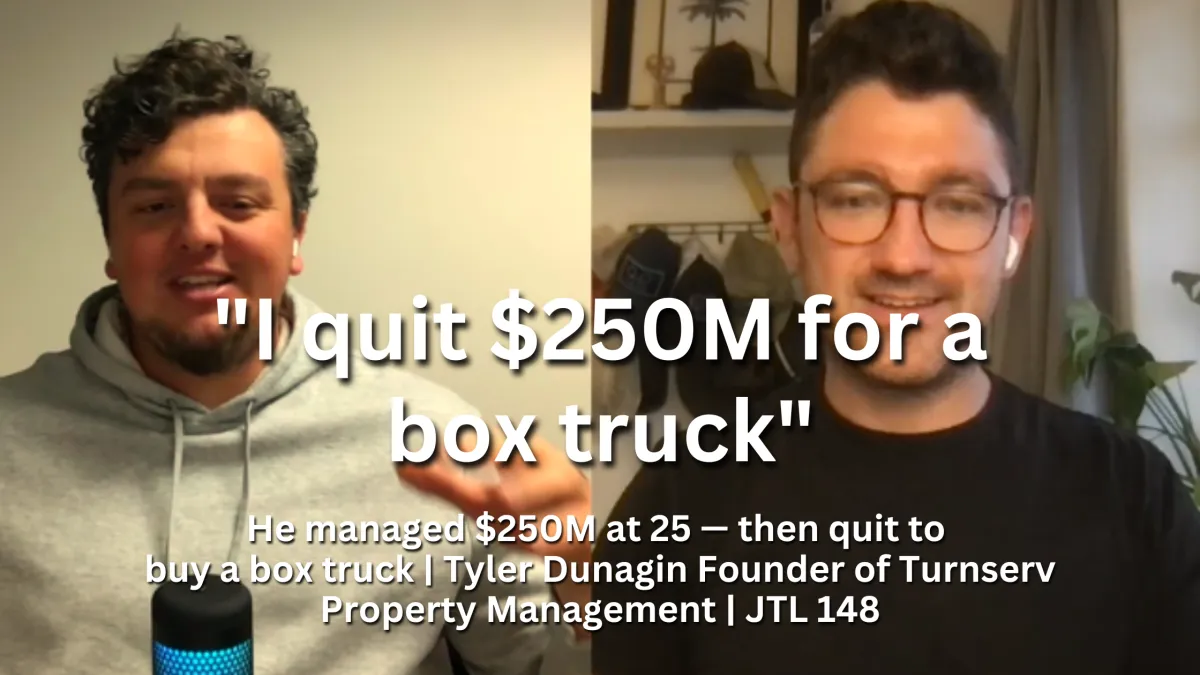
Why Your "Why" Is Allowed to Be Selfish (And How That's Actually the Key to Building Something That Lasts)
Want to hear the full conversation? Listen to the Journey To Legacy podcast Episode 148 with Tyler Dunagin for even more insights and stories from his remarkable entrepreneurial journey.
Why Your "Why" Is Allowed to Be Selfish (And How That's Actually the Key to Building Something That Lasts)
He was 25 years old, managing a quarter billion dollars in real estate assets, and having panic attacks at his desk.
By every external measure, Tyler Dunagin had made it. Director-level title. Real income. A career path everyone around him said was the one to want. And he was miserable.
So he drained his 401k, bought a box truck, and started flipping apartments.
When his parents found out, they asked if he was sure. His answer: "It's too late. I already did it."
Today, Tyler runs Turn Serve an Inc 5,000 listed company ranked second fastest-growing in its space - alongside a platform of brands and a patented product he invented himself. But none of it started with a grand vision or a noble mission.
It started with something a lot smaller. And a lot more honest.
The myth of the noble why
We've all absorbed the same cultural message about purpose: your why should be big, selfless, and immediately compelling. It should sound good in a speech. It should make investors lean forward. It should, ideally, involve changing the world in some meaningful way.
So entrepreneurs spend months - sometimes years - searching for a why that meets that standard. And while they're searching, they don't start.
Here's what nobody tells you: that's not how purpose actually works.
Purpose doesn't arrive fully formed. It doesn't come to you in a flash of inspiration while you're hiking or journaling. For most founders, it emerges slowly, through trial and error and failure and burnout - and it almost always starts somewhere personal.
Somewhere, if we're being honest, a little selfish.
Tyler's why wasn't noble. It was real.
When Tyler finally walked away from corporate America, his why wasn't "to revolutionise the apartment renovation industry" or "to create jobs for hundreds of people."
It was simpler than that. Quieter.
I need a place where I'm in control. Where nobody's telling me what to do. Where I don't have to sit still when there's nothing to sit for.
No panic attacks. No clock-watching. No shrinking in his seat because a boss was in a bad mood. He wanted a safe space - for himself, built by himself.
That was it.
And here's the thing: that was enough.
Because a why that's honest is a why you'll actually fight for. A why that sounds good on paper but doesn't connect to anything real inside you will evaporate the moment things get hard - and things always get hard.
Tyler's early, selfish why kept him in the game through the moments when most people quit.
Why selfish whys work
There's a reason therapists, coaches, and the more honest variety of business mentors will tell you to start with what you actually want, not what you think you should want.
When your motivation is personal, it's durable.
If you're building a company to "add value to the ecosystem," that framing won't carry you through a cash flow crisis at 2am. But if you're building it because you refuse to go back to a job that gave you anxiety attacks - that will.
Tyler puts it plainly: most entrepreneurs he knows either have a deep curiosity that drives them forward, or they have something they're running from. A void to fill. A version of themselves they're trying to leave behind. Neither of those starting points sounds particularly noble. But both of them are real. And real is what lasts.
This doesn't mean your why has to stay selfish. It just means that's an acceptable - maybe even necessary - place to begin.
How your why evolves (and why it's supposed to)
Here's what Tyler's journey actually looked like:
Phase one - It's about survival. He needed out of corporate. He needed control. He needed to stop white-knuckling his way through somebody else's structure.
Phase two - It's about his family. Once he had kids, the motivation shifted. Not just financial security, but presence. Mental clarity. Being a version of himself his sons could actually look up to.
Phase three - It's about the industry. As Turn Serve grew, Tyler started caring about something bigger: making the apartment renovation space better for everyone in it. Cleaner systems. Fairer access. A company culture where people weren't dreading Monday mornings.
The same why, grown outward over time.
If you're early in your journey and your motivation is still in phase one - that's not a problem. That's the foundation. You learn how entrepreneurs find their purpose not by sitting with a journal waiting for revelation, but by moving, failing, adjusting, and paying attention to what's still pulling you forward after the hard days.
Three questions to start finding your real why
You don't need a coach or a retreat or a vision board. You need fifteen minutes of honest reflection and a willingness to write down the true answer, not the impressive one.
1. What am I currently running from?
Not in a negative sense - in a clarifying one. What situation, environment, or version of your life are you unwilling to go back to? That aversion is information. It tells you what you actually value by showing you what you can't tolerate.
2. What would my ideal Tuesday look like?
Not your ideal vacation. Your ideal ordinary day. Where are you? Who are you talking to? What kind of problems are you solving? The granular, mundane version of your dream life reveals more about your real why than any big-picture question.
3. What would I keep doing even if it didn't pay for another year?
This is the filter. Whatever survives this question has genuine fuel behind it. Whatever doesn't probably belongs in someone else's company, not yours.
The permission you didn't know you needed
Tyler Dunagin is not special. He'll be the first to tell you that.
He wasn't the smartest guy in the room. He didn't have a network or a business degree or a family with venture capital connections. He had a curiosity he couldn't switch off, a tolerance for discomfort he built over years of sport, and a why that was honest even when it wasn't impressive.
That was enough to start. And starting with whatever real, imperfect, slightly selfish reason you have right now - is the whole thing.
The why gets bigger as you go. But you have to go first.
Tyler Dunagin is the founder of Turn Serve, an Inc 5,000 company and the 2nd fastest-growing in its space. He's also the inventor of Liquid Liner, a patented bathroom renovation product. Hear his full story on the Journey to Legacy podcast - available wherever you listen.
Transcript from interview:
WAYNE:
There are far less qualified people doing more than most people just because they decided to start and take a swing at things. And then those people realize like, Hey, it's a low gate man. I could do this again and again and again. Once you do it, once you're hooked and that's it. One of the best things you can do is do nothing for an hour. And and our brains try to tell us like, no, you gotta, you gotta go occupy your mind. You gotta go get your hands dirty. You gotta go do something else, fight it. 'cause you're going to reach a new level when you start doing that. I, it's, it's a superpower. It really is. I. At just 25 years old, he was managing a quarter billion dollars in real estate assets. Corporate America had given him the title, the income, the Career Path everyone said To Want, and he walked away from all of it. He drained his 401k, he bought a box truck and some paint rollers, and he started flipping apartments. Its parents asked him, are you sure? And he said. It's too late. Already did it. Welcome back to Journey to Legacy, the show where purpose-driven entrepreneurs share the real story behind the impact they're building. I'm your host, Wayne Veldsman. My guest today is Tyler Dunagin, a serial entrepreneur who went from semipro football to corporate real estate and then walked away to build, turn, serve. Today it's an Inc 5,000 listed company. Ranked second fastest growing in its space with a platform of brands and a patented product that Tyler invented himself. In this conversation, Tyler gets into why curiosity beats credentials, what it really takes to find your why, and why your why could change more than once, and also the counterintuitive habit that he unlocked and uses. To foster his best thinking as a founder, he also makes a point that will hit many of you pretty hard. How far less qualified people are doing far more than you are, not because they're smarter, but because they simply decided to start. Welcome to the show, Tyler Dunagin.
TYLER:
You know, my goal, the reason why I do these is just to connect. I've learned that you have no idea where your next, you know, networking thing's gonna come from. No idea who's gonna recognize you or who you're gonna learn from, and vice versa. I don't have any courses to push or anything like that at all. I'm just a serial entrepreneur trying to connect with people, doing cool things, having cool convos. That's my goal. My goal is to have very authentic conversations in 26 and to see where it goes. You know, that's what this is about, man. So really just me connecting people that are aspiring or trying or changing or doing anything like that at all.
WAYNE:
Beautiful. in, man. Beautiful, beautiful. What interesting connections have come from doing different shows or podcasts?
TYLER:
Oh man, it's been crazy. So, one podcast I did live and this was down in Nashville. Of course I had to make the trip down there, and it was the first time that I had n Nashville Whiskey. The first time I had whiskey at all. I don't drink much. And, uh, you know, just, I, I, I took me two hours to take a shot like that, you know, that big. And I'm just hanging out down there, just experiencing it. I'm walking through downtown Nashville. It's loud. My, you know, my C'S just going crazy. But when I was there, you know, I sit down, the only non-loud restaurant happened to be like an Arby's or something like that. I'm like, whatever. Like, let's run with it. And I sit down next to a bunch of building developers just by chance that were in the area and they had a massive amount of portfolio potential customers for us. And now we're connected. We go to a conference together, you know, so they kind of segue into, you have no idea what you're gonna find. And then addition to that, like I had a couple introductions through, Hey, I saw you on the pod. Hey, like, listen, I, I have an idea for you if you gimme five minutes, I'm sure. Of course, man. I'll give you time. Let's go. And, um, we, so one of our companies is a flooring company called apartment flooring.com. And somebody said, Hey, I, I have direct source options for you. I just need to make like 5% on this stuff, but I know I can get you right into this. Avoid all the big retailers, avoid this. Normal suppliers buy from me. Boom. Here you go. And honestly, dude, they, they cut our price down by like 30%. It was insane. way. Oh. so like small things like that. And then also like in addition to it, I don't think somebody jumps on this and they see me like, oh, like I wanna buy from here. I go. But instead, I think if somebody's researching me, the company and like whatever else it is, I think if they happen to see this or if there's new exposure or something like that, it brings some public validation. And there's an element of it to where like, hey, he's a real person. Like, hey, he has conversations with Wayne. You know what I mean? Like Yeah. And I think that goes a long way. And then last thing I'll say is this. It's so funny, one of my companies, so I invented a bathroom product called Liquid Liner. That's what that is behind me, right. It's a patented product. It's for bathtubs. It's a space I'd never thought I'd be in. I can't believe like I'm talking about this, but here, it's my reality. Uh, I did a lot of promos. I used my podcast. I made a lot of clips for TikTok and, you know, we, we promoted them and I took my son to Subway, food chain bias and, somebody comes up to me and he, and he, and keep mind, man, I'm real easy to talk to. I'm real like. I, I do some things, but at the same time, like I try to be me all the time. I have some, some dude come up to me, he's like, Hey, man. And he was nervous and I was like, well, what's going on, man? Like, you, y'all good? It's like, what's going on? He's like, uh, I don't know how to ask this. I'm like, it's all good. Just ask me. I, I, I've heard worse. And he's like, are you that bathtub guy? I was like, I was like, what? And he is like, yeah, man, I saw you on so and so podcast, he's like, is that your bathtub product? Are you the liquid liner guy? That is insane to me. I was like, how? I was like, I've never been recognized as a, bathtub guy before, man. And he was like, oh, I, I watched that podcast all the time. He's like, I thought that your, your product was so cool. And my son's sitting there, my son's laughing at me. And we left there. He is like, what's up bathtub guy? You know? So I'm like, all right, dude. Uh, but those, those little moments, it's kind of cool. There's some validation there. There's, hey, like these things do work, you know, you have no idea what's gonna open up. And I, I did have somebody offer me, um. He, he does podcasting, but then he says, Hey, do you do public speaking? I was like, well, you know, I do like conferences and things like that, but I don't really advertise for it. He says, dude, you're joining my team. He's like, you're gonna do public speaking. We're gonna get you at some events and whatnot. And Wayne, I've, I've never prided myself in being the most thorough, most articulate guy. I'm just trying to be authentic. And he's like, man you, you got it. He's like, I'm gonna help you. You're gonna be a public speaker. Here you go. I tell my wife, and, um, I was like, yeah, this guy, you know, he says he'd gimme like five grand an event and this, this, and she's like, fucking do it. And I'm like, all right. So, um, you know, and, and, and that, those moments, you have no idea what doors are gonna open. I had zero intention on ever considering doing that professionally, Yeah, like I'm in the inner works of joining this guy's team and training and all those kind of things to do it. So just as long as you go into 'em, open-minded, man, you know how this goes. You have no idea what doors will open up.
WAYNE:
I love that man. Tyler, we're just rolling by, by the way. yeah. Where did, this way? There's a lot of people in this world that are closed off and they think that the world is bad and people are out to get them. Boy, you are literally teaching us right here is just be open, make connections. You don't know what's gonna happen, and you just gave us two, three examples of goodness that comes out of it.
TYLER:
Yeah. So to entry question, I've always been wired this way, but I didn't realize I was this way until it was okay to be. And here's what I mean by that. When you're younger, you're trying to figure out the world. I always felt different than everybody, man. I thought there was something wrong with me for the longest time because I just like, man, I don't want to do those kind of things. I don't wanna be told what to do. There's gotta be a different way of doing things. I just always felt different, man. Like, I struggled with it my whole life. And then like after high school, I had friends, all those kind of things. Don't get me wrong, I was, you know, multi-sport athlete. I was also a nerd. I played RuneScape every day of my life too. So I went from like Allstate football and all Nike to being like one of the best p carriers in RuneScape. So I was in a different space. But to answer your question, I think that, like, I've always been naturally curious about things, and I've always just been open-minded and just like, I wanna explore something. If somebody's doing something cool, not in a judgmental way, I just want to know what are they doing. Could I assist in any way? Could I do that? Like, I'm just naturally fascinated by it. Not 'cause I want to compete, but just because, I'm curious about it. And so like those, I think that natural wiring, you do have a competitive background of sports, you do have a curiosity about things. You do have like an engineering, like first principles kind of approach to things. And that, that I, I don't know if I was born with it or if I acquired it, you know, but like, it's always been a part of me, man. And, uh, and my dad had a business, uh, and I watched him growing up. My mom has always been on the edge of doing her own things, running daycares and, and whatnot. Like, so nobody, like, I don't have any like Jeff Bezos in my family, but I have like realistic people that start companies and they think a little bit differently, strong work ethics and whatnot. And for me, like I, I don't know, just this is all I know. It's, it feels so natural to me, I guess I always had been this way within reason, but now, like in my adult life, I'm, I feel it's a good word for it is probably an acceptable time to be this way, versus like, in school it's, Hey, your son's weird. He might have ADHD, Hey, he might like X, Y, and Z. I hear what they're talking about. Like if they're talking about algebra, I want to talk to the guy about his roller blade shoes that this came in, you know, so yeah I've always been out there a little bit or a little bit different. I, I would say.
WAYNE:
interesting man. It's like, I dunno school specifically society puts everybody into this box of be this one way, structure this way. I mean, is it literally like government control even that it's trying to make the masses here, get the nine to five job, be the cog in the wheel when there's individuals like yourself that are like, you know, thinking differently. I'm over here. I'm like, oh, how did you become this way? You're like, well, you know, I just didn't actually let the masses, let the man like put me into the box.
TYLER:
Hundred percent. And I agree with you. I think that schooling's one of those things. So I'm not anti-education by any means. But I do think that knowledge comes in many ways. A lot of the times it's traditional education, which has its flaws. But I think that some of the times that's all that's available. However like you can acquire knowledge in non-traditional ways. Like I read books, I do all those things. I talk to mentors. I try things. There's people that have zero education at all. And what's that term called? Like an autodidact or something like that, where they're self-taught and whatnot. And they still have the same amount of knowledge or more than somebody that's highly educated. I have three kids at home, by the way for reference. And I have a 2-year-old, a 4-year-old, and 12-year-old. You know, obviously like we're 12 year old's great in school, social butterfly, straight, A student athlete. Trey's amazing. Like I, I love him so much. He's great. He is, he does not struggle with school at all like I did. Just, he's patient, he's thoughtful and he can sit still. I could not Now my 4-year-old who start, who's supposed to start school in a year, not so much. He's exactly me. I don't see his feet sit still. I see his century, you know, nerves going off all the time and we're probably gonna homeschool him. You know, just to kind of adapt. But where I'm going with this is, you know, I think that education in itself is going to have to change. You have these things like Montessori, you have private schooling and, and, you know, eventually you're gonna have more and more and more like online curriculums and all these kind of things. And that's just gonna be the new norm. But the, the what's taught has to change. Like it has to adapt, it has to catch up to the time. You know, you mentioned the nine to five and you mentioned the factory workers and why those came around. And, you know, capitalists kind of set the tone of what goes into the workday and that kind of trickled over to what went into the school day and what was taught and why. You know, I think school early on taught you how to be a really good employee, how to be disciplined and punctual, and clock in, clock out, do a task, don't think outside the box and go home. And I think most people nowadays, they resist that man. Nobody wants to do that. good thing. There are people that are like good at that. But at the same time, like the world's changing.
WAYNE:
That's my opinion, at least. It's 100% changing. Feels, feels interesting that I often feel the same, same That's like, nah, nobody wants to go that way. It's like, why are we that way? Funniest thing is when I, when college, I started my, like my first business, it was this clothing shop, right? And I was pretty much wheeling and dealing. I was working in a glorified sweat shop and I convinced the guy, I was like, yo, let me run a brand inside of this. 'cause we were just printing for other brands. And he's like, okay, well, like, are you gonna do, do it all yourself? And I was like, no, no, no. I'll find people to help me. I'll offer internships. And so I'm going out to. Other students in college that are all my age that have the exact same amount of experiences I do. And I'm like, Hey, do you wanna come be an intern this company? I'm sorry. I'm like, this is ridiculous. Like, why would anybody, and they're like, oh yeah, please, that sounds great. Like, tell me to do. sitting here, I'm like, you know, you guys could do this just yourself. I was like, I, Yeah. But it's like learned that's like people think differently and they want to be told what to do and there's nothing wrong with that.
TYLER:
Right? And so maybe that's where, I don't know, society and the school system bred that into a lot of people. But now I think more and more and more people are realizing actually having freedom, being a free thinker is, dare I say, better. Yeah, I, I agree with that. A thousand fold, man. And that's cool. About the brand too, within the brand. That's amazing. You know I think that there's an element, not everybody, like, I don't wanna say everybody that's successful is an oddball, but they probably do think a little bit different. And, you know, there's probably an element, we can make an argument that it's a deficiency to assume that you could do anything, right? Like it's, you're, you don't know the risks or what have you, you're gonna get burned, right? That's part of the process. But somebody like you and I, we could probably look at something and we say, okay, that person is buying this, putting this on it, reselling it for that. And that's a job that's glorified. It's like, okay, cool. That's big. And you mentioned the thing about like the interns and you're like, I can't believe these people. Like, you know, same thing, like when, when I created the company and I created the role, I was like, there's no way anybody's gonna wanna apply for this role or do it. This is so silly to me, and all of a sudden you get 80 applicants. Like they could do this so easily, but you, you said it well, most people don't think like that that way. So to say they want the safety, the structure. They think that there's big hurdles and guardrails and barrier entries that probably don't exist except for in their minds, or they have, you know, unless they are super human and they have such a high level of intelligence where they know the dangers and the body's like, no, don't do this. But I think a lot of the times you just assume that there's more red tape that's required, or hey, this, that happens to big corporations. I can't start that. Like, I don't have a million dollars. I can't do this. There is such a new way of doing things nowadays. It's so easy to get started and most people are just limited, I would say 90% of the population. There are far less qualified people doing more than most people just because they decided to start and take a swing at things. And then those people realize like, Hey, it's a low gate man. I could do this again and again and again. Once you do it, once you're hooked and that's it.
WAYNE:
That is so interesting, man. I had this conversation the other day. It's what you just said, that there's actually a lot of people that are not qualified. They're I'm gonna put it that way, right. In things. Yeah. to try and all of a sudden they realized like, wait a second, I can play this game differently have the same glorified outcome typically of wealth of success. Right. That they said I wasn't gonna be able to have, 'cause I wasn't traditionally smart they were just willing to go for it. Tyler, I'm a, I'm a big mindset guy. Right. So something that you just said there is that a lot of people, they're afraid they see this red tape, they think it's impossible to do. are your thoughts, like how can we try and help people to see differently? Because it's a huge goal of this podcast. It's through stories like yourself of like showing like it's, Like where nobody's special. You were saying that you were not this huge bookworm, right? You had struggled in school even though you were a nerd and an athlete. Right. But you're to think differently. How can people think differently?
TYLER:
Uh, first I'll, I'll preface to like, I think sometimes the people that, that think outside of the box. I don't wanna box anybody out here. I can't think of a single situation of people that I know that came from a very stable home, good dual income, you know, like it's perfect white picket fence. And the, the people that were born in that are able to go survive on their own and do things. I'm not saying that they're not capable, but thinking outside the box and think of the norm. Where I'm going with this is in a weird way, I think that natural mindset, like this sounds like a sharp word, but like interpreted as you may. Most entrepreneurs that are kind of on the edge like that, they either have a high compassion , and urge to do something, or they have some trauma in them that made them think a different way. And trauma could be very insignificant or very severe. It could be, Hey, financial stability didn't exist and it created a lot of hardship for me and my family. And all of a sudden you're like, Hey, I don't care if it's normal or not, I'm gonna survive. Here's what I'm doing. Or it could be something like along the lines of, Hey, I had a bunch of people telling me I couldn't do this. I'm just gonna do it just to, to show 'em that I can. And so, you know, all those things said, I'm not saying that you have to have, you know, uh, uh, childhood of therapy in order to be a successful entrepreneur, but I do think sometimes, like either a deep sense of curiosity, an event in your life, a void that you're trying to fill, like there's normally a reason why people want to start, and that could just be better themselves. That could just be, I hear about this game, I don't have any baggage, but I want to get into it. You could still be successful. I'm not saying that, but I think a lot of the times, the people that start this journey, the people that get into it and stay in it and go full circle, they have a deeper purpose and a deeper reason. And it's not superficial. There are things in the world that you can see with their eyes. They don't move the needle for those people. It's deeply embedded in their souls. It's a thing that they have to prove to themselves or a box that they have to check. There's this, this urge and this obsession with doing different or doing better or, or doing non-normal. Right. And I, it's hard to, hard to kind of explain it, but like at the same time. It's so natural for some people to see it that way, but it's, I say that it's probably, I don't know this number offhand, like this is a made up stat, but probably less than 10% of the population that that can kind of think that way or they're triggered from that. Or they operate from that, you know? And beyond that, beyond like the whole, Hey, I had a slippery slope, like starting off, it was, it could be, you know, hey, like, you know, there's a lot of people doing things that are different. Um, there's a lot of people that are less qualified doing more, and then that mindset is, I think it's this one if you want to bring good, and that could either be to yourself, to others, to customers. If you want to make an impact to your family, to yourself, to customers, it doesn't matter, charity that you're obsessed with, it doesn't matter what the thing is. If it means enough to you, I think that thoroughly you will find a way to do it and survive it. I don't think anything you start is gonna be like, Hey, this works. If, and if, if that's the case, like. Bravo. You are the 1% of the 1%. But I think most of the time to put a bow on this thought is you start something out of necessity or an urge or a survival instinct or something similar like that. You're just sick of the nine to five. You can't take another person telling you what to do, like you just can't do it anymore. Right? And then you start it, and then you struggle and you ask yourself like, is this for me or not? Like, you know, you get imposter syndrome, you think of everybody that's way smarter than you that's doing this. But then you talk to them and they say the same thing. It's like, I'm kind of winging this, but I think it's going well. And they're like, dude, I've been idolizing you for four years. What do you mean you're winging it? It's like, and they'll be like, yeah, Ty. Like that's what most of us are doing. Like we have a good idea, but no one knows how this thing ends. You know? Like, here you go. So where I'm going with all this is, I think it's just, it goes back down to this mindset of always exploring what, what else is out there. Seeing people that are doing things more than yourself and not casting judgment. It's a natural human instinct to say like, oh, look at this guy. Like, you know, he just bought this building, he's rich family, you know, whatever it might be. Or, Hey, look at, look at this person, not a care in the world. Must be nice to have stress over a mortgage. And it's so natural to think like judgment wise, right? But then like you reel it in and you instead, you should frame that as like. Oh, I wonder one, what got them here and I wonder two, what hardships they have. What are their shortcomings that they had to come over to make this successful? Nothing is more important. Like my struggles might not be yours and vice versa. And who am I to judge if I'm making this up? Sorry. But if you can't tie your shoes, I'm not gonna look at you and be like, Hey Wayne, like, what's wrong with you? And if I can't comb my hair, which is true today, like, you know, the same for you. And so all those things go into this mindset of just like, what's more, what's next? Like why not me? Like what is that person doing? Like how can we support each other? There's just, what I've learned is that little circle of people. There's not an expert in that body somewhere. It is a thought pattern that changes. It's not about the thing on the table, it's the thoughts around it. How do they interpret it? How do they solve for it? How do they relate to it? There's just so much more that goes on beyond the meets the eye, and you don't get access to that until that gate's open for you or you open yourself. The corporate world's not gonna show you. Your school's not gonna show you. You gotta dive in, man. There's a whole world. You can call it the Illuminati, you can call it all these things, but reality of it is, it's for the few people that will navigate the door's open for anybody. You just gotta open it. gotta find the courage, the reason to walk through it.
WAYNE:
you talked a couple times about curiosity. done show right now, I think this is gonna be probably episode 150, something like that. I've had a couple other shows, I've interviewed well over 200 entrepreneurs. number one theme I say, how did you get into this? How did you find success? Curiosity, man. Curiosity. They said, yeah, one day I heard about this strange thing, and so I started just deep diving into it. And then it led to this or this or this? Or did you start, you talked about like not casting judgment. Even casting, it's interesting. Judgment seems like a bad thing, but when you see Yeah. ultra successful. They own this skyscraper. I'm gonna judge them saying they know something. I don't know. They're better than me. It's also a judgment when actually it's like, no, how about you just get curious instead? How did they get there? did they do that? Let's figure it out. And end of day ends up being just a, they tried. They just stepped through the door and then the next door, and then the next door, and then they fell on their face. Got up, kept going forward, man. going forwards. Crazy, crazy thing. Tell okay, but here, lemme ask you this. So you started talking also a little bit there about purpose, right? Uh, I know that knowing your why is important to you, right? You've even mentioned the importance of evolving, leaning into discomfort, knowing your why. What is the importance of knowing your why and how do people even start to figure it out?
TYLER:
So I don't think anybody's born with it. And then all of a sudden it registers like, that's my why right there. It's, it takes some trial, it takes some hardship, it takes some stumbling, it takes some chasing the wrong targets a few times to understanding what you do want, what you don't want, what your non-negotiables are, understanding your why. So for me, it's been a journey. And I'll, I'll tell you the quick story of, of my, my pathway really quick. So I, you know, from high school sports to college football, to semi-pro football, to having a kid when I was 23 years old, to then saying to myself, shoot, I don't wanna work in corporate America. I want to, you know, be a wealthy entrepreneur. What, where do I go? And, and for me it was going from single family real estate to hitting a wall. To getting burnout, to not being able to scale it, to then getting into multifamily real estate, to playing the corporate America game. Right? And then understanding like what goes into it, what I despise, how many panic attacks do I possibly have working corporate America, right? And then the next journey is taking a leap of faith and then starting the company that I, I run today in a weird way to solve what I needed in corporate America. And you ask yourself, how do you, how does this relate to your why? Every single step of that journey. When I started single family real estate, I told myself, my why was I don't wanna be rich for my family, and this is it, you know, and then you hit a wall. And then I get in corporate America, I'm like, Hey, I need more structure. And all of a sudden it was the same thing. I'm like, man, I am more stress than ever. And I'm the nine to fiver, man. I'm a clock watcher and I'm still with this panic attacks. I can't do this anymore. And then it was, am I really gonna dive back into entrepreneurship? So where I'm going with this is every single step along the way. It took me getting burning out twice. It took me getting burned twice. It took me losing everything I had twice in order to realize I wasn't chasing the wealth component of it. Sure. Financial stability is important, don't get me wrong. Um, everybody wants to make more money. That's why we get outta bed a lot of the times. But there's more than that. For me, my why was a safe area for me to work in. As silly as that sounds, it was something stable that I was in control of. I can control my destiny. I could appease my curiosity, hyperactive mind if I wanted to. I didn't have to sit at a desk. If I had nothing to do. I could leave freely, come and go, all those kind of things. And what I realized at the time was it started off personal for me and selfish for me, but I needed that. It was for me, it was for me, for me, for me, it was a safe spot. It was something I can control. It, it was me. It was relying on me. And then as I transcended a little bit, you know, you, you talk about your why and that's, that's what started off my why initially. But then I realized like. That's a pretty good why for other people as well, like having a spot where it's not normal, like being able okay. To welcome people that think outside the box. They're not gonna woo you with a Harvard MBA, but their curiosity approach, their way of thinking and reasoning is a little different and that's okay. And so for us. It's not the same thing, but our purpose at my company is to foster wellbeing by beautifying spaces. And you ask yourself, well, what's that mean? Like, you guys must do renovations. I own a painting company, a flooring company, and a few other things. And I do, but that's not what it is. The beautifying spaces kind of relates to the clients about like our services. When I say beautifying spaces, I mean the safe spaces that we're all in. What, what's my day look like? What's my team's day look like? You know, am I, I don't have to, like, is the boss raising the voice today? Am I gonna shrink in my seat today? Like, am I gonna dread coming into the office tomorrow? You know? So like, in a weird way, I wanted to really create an atmosphere and a space that was welcoming for others. And that also went into my why. And then the second that you do have a kid, like your why changes a lot too. Knowing the things that you need. And it's not just a money part, but it's that, Hey, I need some mental clarity here. I need some stability here. I need not to panic all the time. I need to be more stable and present and all these things. And serving your family by being the best version of yourself, as cliche as that sounds. Those things go into your why, man, and where to put closure on this whole thought. It took me going through, you know, uh, freaking out. 'cause I, as having a kid early to, you know, leaving the safety and security that I knew in football and everything, I got validation for before and whatnot. Then getting into single family real estate, not doing a single thing as a 23-year-old. Then getting into corporate America where I was the youngest person managing the most assets in the company. And, and hitting my head there again, I'm thankful for all those experiences 'cause they shaped me. But those also, those were painful moments, but they make you realize your why. Sometimes they make you realize and remember, why am I getting up every day? What am I doing this for? And just as much as they encourage you to keep going, sometimes your why pulls you away from things that are no longer serving for you or fit you. Some relationships aren't meant to be forever. Some positions are supposed to be temporarily meant for you and, and your why tends to pull you through things or pull you around things or over, under things or outta things or into things that you don't know why. But just naturally your subconscious is just like, it's a gut feeling sometimes man. And tho all those experiences, every experience that somebody has listening to this from like, you know, kindergarten up to where they are now. They might not realize it, but they might not know or be able to tell you what their why is. But it's been identified by their subconscious numerous times. And the things that they do want don't want things that motivate them, things that depress them, that's their why, talking to them in a weird way. And so it just takes you going through this process to realize that sometimes. And that's exactly where I've landed on mind. And that's, that's, that's how I've reaffirmed mine and shaped mine and, and just went through grueling years and years of discovery in order to find it and then finally just be at peace with it.
WAYNE:
you just said, their why, talking to them, literally, you realize that's your why. That is speaking to you. Here's a, I amazing takeaway from this. I mean, there's so why changed. Everybody that's listening here is like, don't think you need to out your end all. Be all today. What is my purpose in life? Why do I do all of this? Today you might do it. Why are you doing it? Well, 'cause I gotta buy some food. I gotta fill up my refrigerator. That's why I'm doing it today. That's why I do what I do. why? It might sound bad when I say it like this a couple times was so selfish in the best way, It's that, hey, I need a safe space for myself. I want to make more money, right? I need to stop having panic attacks like before you had a kid, right? All always things are like, that's totally fine. And look how it elevated to now your why. Tyler is all around your family, all around everybody that works for you. Everybody you surround with creating these beautiful spaces that, sure, we haven't talked that much about your companies. We'll touch on 'em in a second, right? That like, renovation stuff, right? Like you are literal, physical, beautiful spaces. exactly what you said is that you're trying to create beautiful spaces for the people that you're affecting, that you're interacting with. How crazy is how much your why can evolve.
TYLER:
Yeah, it comes full circle. It really does. If you can be aware and open-minded enough to reflect and recognize the pathway and be thankful for those, and even in those moments of pain, you can identify 'em.
WAYNE:
Okay. Yeah. Everybody like just taking time to slow down, Recognize how you're growing and changing and what do you need today? Start there, right? We're all so go, go, go, go, go. Even this past week, right, we're recording this. It's like the first week back in January, back to work. It was like Monday. I was prepping stuff for employees and I was like, got the whole agenda. had caught myself. I was like, hold up a second. how about instead, today's agenda is like, let's reflect. was last year? What do we want to do this year before we're just again, in the grind of the day to day and like, what do you think? I mean, sometimes we say that's the most important piece of the puzzle, right? Is slowing down to just think.
TYLER:
Absolutely. And somebody taught me this one. I read the book Deep Work by Con Newport, and it really helped frame this for me, but it took me working with a coach to identify that I need to practice this and exactly what you said and there's probably a lot of similarities between me and people listening to this. You know, you want to get something done, you don't even think, you just go, you know, like you go, go, go. Hey, I'm gonna do it here I go, boom. That's a lot of shallow work. That's a lot of, like, in the moment, that's busy work. Right? And I'm not saying that's not important sometimes. 'cause you're gonna have those moments where I have made the most rides, the most growth, the most reflection and all those kind of things. And the most progress has been those moments of stillness. It took a coach telling me, you know, we talk about productivity in, in avoiding burnout and avoiding whatever it might be. And he asked me, Hey, how much, how much dead time do you schedule a week? And I laughed like, well, of course none. Like, I'm not doing that. And he is like, well, well, why don't we start there? And I'm like, you're joking? He's like, no. He's like, you need to work on this. And I said, okay, let, I'll go into it full, full fledge. Let's try it. He's like, I want you to schedule two hours a day for the next two weeks of doing nothing but sitting down. No phone, no computer. Don't touch anything. Read a book if you want to, read the news, if you want to, but you're not gonna be proactive. You're not gonna be doing anything. And I was like, oh, okay, man. Like, let's see how this goes. And so then the first, the first session of it, I sit down and I'm motivated and I'm excited. I'm like, I got this. I sit down for five minutes in my natural wiring, I feel my legs start jumping. I get all antsy and that urge, I don't know if you ever had this urge, like if you ever had a dream or the phone's ringing, you gotta go answer it. That natural like response of like, you gotta occupy your brain or else you feel like you're falling behind. It's a real thing, man, and in these exercises I realized I was trying to feel fulfilled by doing nonstop and I was spinning my wheels quite a lot. And it took those moments of me carving out intentional time to like unwind. I'm not saying I do two hours every day, but that was the prescription when I first started this, just to make me realize like how active I actually am. Then I started doing some grounding exercises to bring me down. I do some of the most product, uh, highly productive work when I take moments to be still. And yeah, there's times where I overwork and all those kind of things, but I make some of my best decisions and best big new products or soft, whatever it might be. After moments of deep reflection and, and answering and asking myself, who do I want to be? Does this fit me? What am I doing here? What happened there? It's normally more than surface area. What meets the eye? But unless you take those moments to be still and talk about it, you're never gonna recognize it, man. And so for me, it took me reading Cal Newport's book Deep Work, to be able to schedule things a certain way. It took me working with a coach to identify, Hey man, you don't need to be busy 10 hours a day or else you're a failure. Like, it's okay. Like you can carve out time to reflect and do nothing. And that was a big moment for me because keep in mind my sports background, right? You're judged by coaches, how much effort all go, go, go, like, you know, in the weight room and film room. And it was all like, I did it, I did it, I did it. And then if I ever sat in those moments, I said like, Hey guys, I'm gonna sit here and do nothing for an hour. It was always like, no dude can't do that. But in the professional world and developmental world, entrepreneur world, like it's very important to carve out time to reflect. Not the whole day, but every now and then, change your scenery. Like reflect a little bit and be very vulnerable with yourself. That's, that's a hard thing to do, but man, that, that made strides in my personal development when I started doing that exercise. As simple as that sounds, I mean, think of that, think about that for a second. One of the best things you can do is do nothing for an hour. And, and our brains try to tell us like, no, you gotta, you gotta go occupy your mind. You gotta go get your hands dirty. You gotta go do something else. Fight it. 'cause you're going to reach a new level when you start doing that. I, it's, it's a superpower. It really is.
WAYNE:
How unbelievable is that? crazy. to, to 99% of people. I would say that even near two years ago, I would say no. You're, I would laugh also. Right. Ha, good joke. That's so funny. You want me to send in enough, uh, everybody that's listens to the show regularly, they'll note that this is again, a repeat theme that's been showing up, just talking about stillness. It's like, to remember who it was. I had a, a marketing guy on who's had a hundred million dollar launches, like crazy, crazy stuff. And he tells me, he was like, yeah, this is nothing groundbreaking. He's like, yeah, sometimes, you know, if you can't figure out a problem, just turn everything off. an hour timer, just have a pen and a piece of paper and just try and solve the problem. He's like, the first 10 minutes, you're like, oh, I got it. you're scribbling. then you sit there for about 30 minutes and you got nothing. 40 minutes later you haven't read anything. And then all of a sudden just this new door unlocks just sitting in stillness and like thinking, Oh man, it really is.
TYLER:
There's something special that goes with it. We are trained and we are taught to constantly move our wheels. Hey, you think of, hey, success means action, action, action. Don't get me wrong, it is important, but at the same time, it is not everything. Like, it's way better to cool it down and it reflect and, and. It's like going down the wrong path, right? If, if you are going a hundred miles an hour, but you're on the wrong road, as cliche as it sounds, guess what? Like you just cost yourself a lot of time. So it's way better to sit down and be still because also that's what you can talk to yourself a little bit more to and feel like, okay, hold on a second. Let me explore here. Let's let all the endorphins and hormones of the day wind down for a second. Let's see where this goes. Wait, I'll tell you a quick story that I started, doing and it sounds like a prescription that's self-serving and, and like it's luxurious and it is within reason, but at the same time it is completely different on, of how I'm wired. And I'll tell you why we started doing it. So when I'm working with my coach for the first time, you know, like the very first thing, he doesn't tell me this, you know, it's, it's all development, it's all improvement, it's all, Hey, how authentic And in the moment are you like, you know, how wound up are you? How still are you? And he didn't tell me this at the time, but three, three sessions go by and he is like, Hey, I wanna run back our first meeting together. I wanna show you the video. I'm like, no, I don't wanna see that dude. Like, don't show me that. He's like, no, no. He's like, we don't need to listen to the audio, we don't need to listen to any of that. He's like, I just wanna show you your body mechanics and your energy showing. And it was like, wait, I was excited to meet him. And I was like, I, you know, it was a lot of this. And I was moving around, touching my face and my ears and bouncing and I, you know. Yeah. And uh, and he was like. Take yourself out of this. If this is somebody else, describe them. And I was like, oh my God, I can't believe you're doing this to me, man. And I was like, that's a very excited, energetic, maybe anxious person that is ready for your questions. I'm gonna respond quick. I'm gonna hit him outta the park. He's like, yeah, you're prepping. He's like, you gotta quit that dude. He's like, you're already naturally wired tight and that's great. Your energy's insanely high. He's like, you don't need to be anticipating these questions. Just roll with things. And that was some of our work. And one of the things that I did, and I say this and I understand this is a super privileged thing for me to say, this part of it, it took me a long time to be able to get here. So I, I know that not everybody can do this, but there's other things that you can do for this, for me. In the most busy time of the day, I had to find an activity that was completely counterintuitive to pro productivity. So I thought, and at first, like, if, if you can't quite do this all the time, I completely understand that. But for me, I, I often get deep tissue massages and I used to get them at the end of the week and in my head I'm like, alright, cool. Hey man, I just, I knocked off Friday, I'm gonna be at 90 minutes. They're gonna beat me up. It's gonna be so relaxing, like it's gonna be great hot stones, you know, you name it, uh, CBD oil. Let's do it. And then, um, you know, my coach said, he's like, cool, I want you to schedule those every day for the next two weeks, uh, at like 12 o'clock. And I'm like, what? Like during the workday? And he is like, yep. I was like, no way. I'm not doing it. He's like, yep, we're doing it. And so I remember driving to the, the massage parlor and I scheduled these things out and I have great masseuse, all these kind of things. And I remember sitting down like, struggling with a thought of this for a moment as so use of sounds, and we talked about being pent up and busy. Talk about going to massage parlor on Monday at noon when you're running a company that has 60 some people and trying to force your brain to, you know, take your shirt off, lay down and relax and be still and unwind. I'll be honest with you, the first like 30 minutes I was a mess man. But also at the same time, I couldn't sit, so I couldn't find my peace or, or anything like that at all in my masseuse. I told her what I was doing. She goes, I'm here for you. I'm like, all right. Like, we'll get through this. I called my coach 'cause I couldn't get, I, I was like, man, I'm struggling. He's like, focus on your breath. And as silly as it sounds, you ask you, you might say like, how do you not relax during a massage? Well, listen. Like, if you are constantly on your toes and you're wired tight, it's a, it's kind of metaphoric for the how we approach a day. We start our days at nine o'clock, we have to do all these kind of things. We're never like, we never pause, we never reflect, we never listen. We never like try to be intrinsic at all. So in these massages, it took me probably four or five sessions of 90 minutes each to finally be able to be still. And then the masseuse started saying, you know, Hey, on your fourth visit, your. Well, I don't even know what they call it, but how tight your skin is. 'cause your muscle, like, whatever. She's like, your first day you were like, as severe as it gets, you were level four. Like, which is like the worst on the scale. And then halfway through the week or towards the end of the week, she's like, you're all the way down to a one. I was like, I feel so much more relaxed too. And where I'm going with this is, uh, you don't have to get a massage. But if you carve out, as silly as it sounds, if you carve out maybe 30 minutes in your busiest assumed time of day, and if you just do a grounding exercise where your phone's off, your computer's off and you truly like you sit down on a chair, you lay down on the floor and you do nothing. When you have that feeling of I gotta do something that's gonna really retrain your brain to be able to take a big, deep breath when you feel like you can do nothing except hit the gas and go. When I started doing that little break and, and that, that massage exercise it was torture first, to be honest with you, because, you know, my muscles were relaxed, but my brain was fighting me on this, but it was necessary is where I'm going with this. And it took that reframing to really be able to reflect. And now in my day, in those moments where I'm like, oh shoot, it's 1145, I haven't done anything yet all, and I go into almost panic mode. I stop and I say, hold on, let me reflect here. And last thing I'll share, I'll pass it back to you, is this. My coach says to me, Ty, I want you to, to meditate for one hour on Thursdays. My busiest day. He's like, find an hour to meditate. I'm like, roto, man, I don't, I don't have an hour on Thursday. I'm like, I've, I've played ball with you on all these other aspects, but man, a an hour on Thursday not happening. He's like, oh, shoot, man. He's like, okay. He's like, you gotta find two hours on Thursday to, to meditate. And I'm like, all right dude. Let's try it. And so I remember that Thursday, I'm partly mad at him, but I also love him, so I'm like. All right, I'll try this out, dude. You know, 15 minutes, I'm like fighting the urge and I finally just let go. And all of a sudden all those things in the week, you know, that, that went into like, oh, I gotta do this. All the stress, the self-imposed limitations and deadlines and everything else noted away. And then I revisit a problem. I'm looking at it, I'm like, why am I putting this off? Why am I stressing over this? It's a level one issue and I'm giving you a level 10 priority. But it took me reflecting. Right? And I think the same could be true, when you're in school, for example, you hear like these things to do, get a job, do all these things, and they're level 10, they're made to be these big events, right? Um, and I'm not undermining them, but like a lot of the times they're way larger in our heads than reality. And sometimes it takes going through an exercise, like a grounding exercise when you're in complete go mode to be able to reflect and make more progress by sitting still. So it's, it's this journey of development, it's a journey of reflection. It's a journey on where you're at. And sometimes it takes being super uncomfortable for, for, for very short periods of time in order to. To reflect on it and realize it.
WAYNE:
Hmm, power of slowing down and reflecting. It's so funny that you're like, yeah, man. It's, it's literally, it is an exercise, right? And it's yeah, So uncomfortable. Like, I'm, I can feel it completely. I mean, there's probably people that are listening, right, that are like, oh, that is absolutely ridiculous. And it's like, no. yeah. endless things that you could be doing. Right. Especially for, I mean, Tyler, how many, how many companies, I guess would you say, are you running right now? Uh, like, but different brands.
TYLER:
So all in all, I, I probably, I say I have like four core brands that I run but then I don't tell my coaches part, but I also like am involved with like three others that are like, kind of like side projects. So, but I, I would say, I'll say four. perfect point of the matter. That why I wanted you to share that is that there's not just always endless stuff to do. There's more that can even be done, right? That it's not like you're just running one company that has 60 plus employees. It's, oh wait, but I could start another company. Oh wait, but I could start another company, say, oh, but I can get involved with this project and that project. There's always more, but look at this power of slowing down. It's actually a what has probably allowed you to be able to manage all of these different brands and get involved with even more, right? This argument of, ah, there's just not enough time. There's not enough hours in the day. Somebody that's working a nine to five that thinks that they can't get through their work versus somebody that is involved with 5, 6, 7 brands all have the same amount of time. Everybody, it's all strategically how you use it I say, it's like slowing down to quote unquote not do anything, can be some of the best time spent. Absolutely. And, and for those that are like contemplating it and like, hey, like how do you do four or five, six? I started with one. You know what I mean? And, uh, there was a lot that was learned in that path. There's a lot going to two, then going to three. In one regard, it does take slowing down and reflecting and aligning and all those kind of things. But at the same time if I didn't have the, what's the right way to say this, leisure slash displeasure of learning the hard way on the first one, I would've never found the tools or develop them or, or beyond to do 2, 3, 4, and five. You know? So, in a weird way, once you acquire the, the skillset, once you have a little, little bit of luck, it does get progressively easier. But the first one is definitely the hardest. I.
WAYNE:
Tyler, earlier you mentioned a little bit about your journey and like we're quickly running outta time here. Gimme just that little synopsis again from school athlete, you know, to company that you started Nine to five. Give us just that whole little synopsis
TYLER:
Yep. So, my dad had the building company. I watched him growing up I was, I was one of those kids, like I could be a book nerd and be smart, but at the same time, like I didn't have the bandwidth or retention span. I didn't care. I didn't struggle with school, but I just got like the. Bare minimum, like GPA to have like the whatever the second, like the merit rule or be at least be eligible for, for sports. I didn't care beyond that at all. I played football, you know, like I had luck there. I worked my ass off in that, in that regard. I ended up, in high school, I was on Nike and football. I went to college to play football. Ended up being a small school I did play semi-pro, but that was gonna be it, um, whole time. Like just had every other interest in the world except for, except for school. Not that I'm like anti-government or anti anything like that at all. I just, like, in my head I'm like this is cool. Not, and I'll do it, but like I, this is not fun. Found out early on when I was playing semi-pro, like NFL Dream dream's probably not gonna manifest, right? And that's all good. I ended up having a kid super early, with my now wife. We have three kids together. But, you know, her and I were not planning that first one. And I remember the day that she brought me the, you know, she's like, Hey, we're having a kid. I. Excited but panic. I'm like, what do you mean? Like, and so that, that, where I'm going with that is that kicked me in the butt to really like, okay, hey man, like you gotta let go of this validating football dream that's never gonna happen and you gotta go make some money. So I talked to a couple people and I watched like the same TV shows that we all see, like house flipping and all these things. I got in single family real estate. And that's just your normal American house, you know what I mean? Like your average one, you drive down the street. That's what it is. The only thing is I didn't have money and I didn't know how to flip a house. And so I actually started my first company and I was doing handyman services for real estate agents and investors, and I just learned from them and I was like you want your gutters done? Cool. I'm gonna call, call a gutter guy. We're gonna work together, but I'll, I'll own the project. So I just started learning as I went. And the next thing you know, like I went from doing handyman to doing full house flips for investors, and then I started putting up my own money and I was my own investor and I'd partner with people, you name it. I had about 15 people with me at the time. And I just realized every single day I started my job. At either a job site of a dilapidated house that needed all this work or Home Depot, and that was it. And like, it was cool for the first, I don't know, six months, but after that I'm like, this sucks. I didn't have the managerial skills I have today. I didn't know how to delegate. There's too many variables. I was learning on the fly, like, man, like there's too many, too much going into it. I went to a mentor and I said, Hey, like, this is what I'm going through. It's everything I wanted, and I got it. But I, I hate it, man. I'm burned out, like I hate this. And he said, you need to get in a multifamily real estate. I said, okay do it. And this is a guy that probably manages a couple billion dollars worth of real estate, uh, owns a massive company, has around 2000 employees. And I got lucky 'cause I called outreach to him and he, and he invited me into his office. That's another story. He said, Hey, you, I understand there's single family stuff. He's like, that's why I don't play ball in single family. He's like, you need to work on a hundred million dollar buildings and get, get in there. And I said, that's a tall step. Let's see. And he's like, start consulting in corporate America for multifamily properties. I said, okay. Do you know anybody? He got me in somewhere. And so I go from flipping houses and being my own boss to working consulting for a third party management company. And, um, you know, when you start in property management, you realize your job title means nothing and you do everything. Um, so from leasing to maintenance to you name it, I'm like, what did I do? But it taught me the basics of that industry, from ground level maintenance to leasing and marketing and sales to retention and asset management and beyond. One day. So I'm, I'm learning, I'm still flipping houses on the side too, and I'm like, all right, I'm gonna get into multifamily buildings and do this. Uh, one day the, the owner I was, I was, um, managing for, 'cause he had a third party management company and I was working like, kind of between him and his management company. And, uh, he approached me and he said, Hey, I'm gonna fire that management company. I thought that was it for me. I was like, oh man, like this is gonna be it. And he says, no, no, you misunderstood. I'm gonna fire them and you're gonna run my whole company for me. I was like what I was like, alright, man. And I just told him my shortcomings, like I'm fearful because of this, this, and this. I think I'll do this. Well, he's like, no, no. He's like, you're my guy. I said, okay. And so like, it was weird, but I just started consulting not too long ago, like a couple years. And now I'm firing the third party professional management company and I'm rebuilding the guy's systems for his whole portfolio. It's around a quarter billion dollars in assets. I started from the leasing and sales operations to the maintenance programs, to preventative maintenance, to the asset acquisition and divestment to legal and accounting and every step along the way, Wayne, I had no idea what I was doing, but I showed up every day and I learned from people that were doing it and I learned on the fly. It engraved in my head of what it went into managing these assets. It was during that journey. We did everything well. Like we had a good system set up. We had everything going. I couldn't find vendors like we had. We had thousands of apartments that needed flipped every year. 'cause half of renters move out every year. So if you have 2000 apartments, you need a thousand unit turns. It's hard to find that many vendors. I actually started my company today, turn, serve out of necessity when I was in multifamily management, because I couldn't find vendors to show up to flip my apartments for me. So I took my house slipping crew and I said, Hey guys. Pause here, come flip an apartment for me. And they were so excited 'cause we went from all these variables to nothing. We went from like foundation issues and plumbing issues and roof issues and all these things to, I show them an apartment and I said, Hey, this is a big rectangle, same color paint, same carpet in all of them. Uh, change out the faucets and this is it. And then they said, how many units are here? I said, 300. And I said, all them are identical to this. And they're like, let's go. And they came in, they flipped that apartment for me in like, you know, two days. And I was like, holy shit. Like this is, this is viable man. Let's do this again. And I started flipping them for like my own management company at the time. It wasn't like a business at first, like I just, I paid them what I, whatever I'd pay like the same vendors instead. And the owner was cool with it. And he says, um, and then we're doing like, more and more we're doing 20, 30, 40 apartments. And I got the systems systems built. I have buddies in the industry asking me to help out, like let my crews go work for their properties for a little bit. And that's when it kind of clicked for me. And I was like, you know what? Like this is a viable path. I don't wanna be in corporate America. I think I learned what I needed to learn here. I went to the owner and I said, Hey, like, listen, I've improved your portfolio. I hope you get rid of your third party company. Your whole estate and your family is in complete control of this thing. Here's your KPIs. Your occupancy's high, your, your rents are high, your costs are low. Man. I was like, I never came into this to do this full time. I was like, I've been here for a couple years. Are you okay if I venture off? And I, I try this. Like, I don't wanna leave you high and dry. He's like, no, you've done a beautiful job. Thank you. You're always welcome back here. He's like, as long as you flip my units for me, we'll call it good. I was like, cool. And I got a customer like, let's go. And so. To, to bring this full circle, that moment of like leaving a stable job like that and making a good amount of income to completely depleting all my savings, wiping up my 401k and going from this white collar, like a plotted job based on public standard. Right? And being a director, I was 24, 25 years old, managing a quarter billion dollars, in assets and, and then all of a sudden. Selling everything I had, buying a box truck and paint rollers and just my, my parents like, they're like, are you sure? Dude? Are you sure you want to do this? I'm like, it's too late. I already just milked out my 401k. And they're like, oh my gosh. And so, but luckily it's one of those things where I had to take the leap of faith. I could not have scaled the company as I did if I stayed in corporate America. And it started off a little bit slow, but I, by, I left corporate America in like twenty seventeen, twenty eighteen. Turn Serve was born a year before that, just like officially to kind of track like my maintenance crews, so to say. And by 2020 we went to Market and I remember having our first like, three apartment units that month, and it was me. I'm like, I don't know if this, this idea's gonna work. And I did them. Just me and my wife, she was helping me clean and all these kind of things. She worked for free. And then all of a sudden, like, I remember like the next month we had triple the amount of apartments submitted to do and I kind of freaking out for a second. Like, oh, I was celebrating and I said it works. But then all of a sudden it was like, oh no, like now I, now I gotta like afford all this and cash flow and do all these kind of things. But we figured it out man. You know, we started off doing a couple apartments a week and then that turned into five a day and that turned into 15 a day and you know, you kind of build out systems and whatnot. Fast forward to today. You know, my company was listed on the Inc 5,000, which it's cool to say aloud. I don't say this to brag, but it's kind of a surreal moment. It's that list is for the fastest growing companies in America. And it's funny, I told my dad that he was like, yeah, sure, sure man. In a playful way, you know what I mean? But it's kind of cool to reflect on. And we were actually the second fastest growing company in our space, in our state that year. And in those moments, you're reading your company's name, what you just kind of like scratched on paper and like made work, and all of a sudden you see accolades of like one of the fastest growing companies in America and you're expanding. We got family office money and all these kind of things. And it just, it was the first time I stopped and paused for a second. I'm like, holy crap. What have I been up to, man? This is cool. This is working. And today, you know, we started off doing one or two services with, with Turn Serve, and now it's a platform of brands. You know, we have apartment painters.com, apartment flooring.com. We have Liquid Liner services. I have a patented best in class product that I made. I'm an inventor now, and I, I am not a chemist, all these kind of things, man. And, and they just happened because I was able to reflect a little bit and one foot in front of the next. I was never an expert in anything I did from managing corporate America to flipping real estate before that, to growing the company like I have today. I mess up a lot, but at the same time, when I talk to mentors and people that are running big companies, and I expect them to have it all figured out and be experts. So they'll literally look at me, SHR shores, like, I don't know how to do this. Let's try to figure this out together. It's more so about their mindsets is, is where I'm going with that and, and problem solving and whatnot. But that's my journey in corporate America, from entrepreneurship to corporate, to entrepreneurship again and taking the leap of faith. And, you know, here we are today and I have no idea what, you know, 28, 29 30 looks like. But for right now, we're just gonna keep on scaling and growing turn serve man. And, and we're, we're going into five cities today and expanding there outward. So it's kind of surreal there. It's. It's such a bigger company than, than beyond myself. There's no way I could do it on my own. And that part's kinda scary, but that's where like, you gotta trust your team, man. So, um, all these things come full circle. When I thought I was a failure in single family real estate, ah, this doesn't work. I can't stomach it. To then transcending that experience into multifamily, then the corporate America and making it all one, it all panned out at the end, man. But, uh, it was, it was a journey to get here. But that, that's, that's my story, man. That's my pathway. it's Todd, thanks for, thanks for sharing, man. And that's only the journey thus far, Like Yeah. more to come. Uh, great job sharing that and everybody, I, I to share the whole point of being, say it right to your face, you're nothing special.
WAYNE:
Right. Right. A hundred percent. And it's A hundred percent, man. thing. I am nothing special like. Yep. just, just start and figure it out along the way. Right? yourself, eh, fail, go back to corporate. Eh, you don't like it. Nah, pivot. Go work for yourself again That's it. Forward. That's what the journey is all about. I'm like, that's such a big piece of like this podcast, right? Is telling the journey, uh, for entrepreneurship is a big piece of it, and then eventually wanting to leave a legacy on this world. And so Tyler, how I like to sort of wrap up the podcast every episode is, uh, to ask entrepreneurs about legacy. What does legacy even mean? And then, uh, what's the legacy that you hope to leave on this world?
TYLER:
Leave an impact. And I don't know if, if that's a cop out, if I can call that legacy or not. But when I, when I think of things beyond me, like I mentioned earlier about, you know, the companies I run today, I could not show up and do it on my own. And I like that component of it. Like, we are changing spaces for people. I'm creating jobs for people and doing all these kind of things. I wanna leave an impact far beyond. I wanna make the industry better. Uh, and I don't need the accolades with it, but I want people to have better peace of mind at work. I want our customers to be a little bit, you know, better off quality of life to be high, my team members to have like equal access and all these kind of things. And I wanna make sure that my sons could look at me and say oh, he did it his way. He did things how he wanted, not how he was supposed to do them. You know, he thought he thought his own thoughts. That's legacy to me. You know what I mean? And le leaving a lasting impact beyond myself, beyond my family. Leaving a good impression, so to say with somebody. Elevating other people in this journey as, as silly as that sounds, I, you know, some people might talk about legacy and it's like. Big house, big car, like big trust fund, whatever. Listen, there's a part of me like I want financial security for my family. Don't get me wrong, but those things fade, man. Like that means nothing. At the end of the day. The only people I'm trying to press right now, other than myself, are truly my kids. Like I really want them to be able to look at this and say, my dad did some cool shit, man. I want them to be able to say that and, Hey, he did this before anybody else did it. No one else taught him how to do this. He cut his teeth and now all of a sudden this pocket of the industry is that much better because of it. I wanna make sure that when people like reflect on that, they, they can understand that one, the amount of impact was that was needed in the space I played ball in. But then two, the amount of effort that not just myself, but the team and everybody else around me. Put into it in order to get to a certain spot, man. You know, so if I could help out people, on that part and leave a legacy like that, or be, give a legacy, if, if I could bring nothing other than giving people an authentic version of what it looks like, what goes into it, what's required and what's not, and not gaslight people, and not sugarcoat things, and not sit here and say I'm so smart. Guess why you can't do this. Here's how, like if, if I could give anybody, like any hope that any ordinary person can do this and take a step in that direction, if I can encourage one person to either start or one person to stay with it or make an adjustment and not fear public outcry or the self-imposed judgment, so to say, that's what it's about for me, man. All the other stuff that's secondary. But if I could help somebody in, in that regard, that's what, it's truly, that's what's impactful for me.
WAYNE:
That's what it's all about, man. Don't follow the norms. Think independently, moves that are gonna impact others. Beautiful. thank it. for everything that you're doing. You're making a huge, huge, huge impact on this world. Uh, there's absolutely no doubt about it.
TYLER:
I appreciate that, Wayne. Thanks for having me. Thanks for listening. My story, it's been.
WAYNE:
And that's a wrap on today's conversation with Tyler Dunagin of Turn Serve. What I love about Tyler is that he doesn't dress it up. No shortcuts, no guru playbook, just someone who kept moving forward and figured it out as he went. Before you go, three things I want you to take away from this conversation. Number one, your why is allowed to change and allowed to start selfish. Tyler's early motivation was simply creating a safe space for himself. No more panic attacks, no one telling him what to do. That's enough to start. It's only by honoring that, that his why eventually grew into his family, his team, and the industry. He's reshaping. Don't wait for a noble reason to start. Start simply with the real one. Number two, stillness is not wasted time. It's a competitive advantage. This was a crazy story, huh? Tyler's coach made him schedule two hours of doing absolutely nothing into his busiest day of the week. It was for sure uncomfortable, but it produced some of his best decisions. If you're going a hundred miles an hour in the wrong direction, speed is your enemy. Slow down to go further. And then number three, the barrier is lower than you think. Tyler said it plainly, far less qualified. People are busy doing far more than you are not because they're smarter, not because they have more resources. They've just decided to start. And then finally, I'll leave you with this. When I asked Tyler what legacy means to him, he said he wants his sons to look back one day and say. My dad did some cool stuff and he did it his way, not how he was supposed to, but how he wanted to. I think that's something worth sitting with, and this episode added value to you. Share it with one person who needs to hear it right now. If you haven't yet, come join our community over at journeytolegacy.org. That's where the real conversations continue. We'll see you next week on Journey to Legacy.


