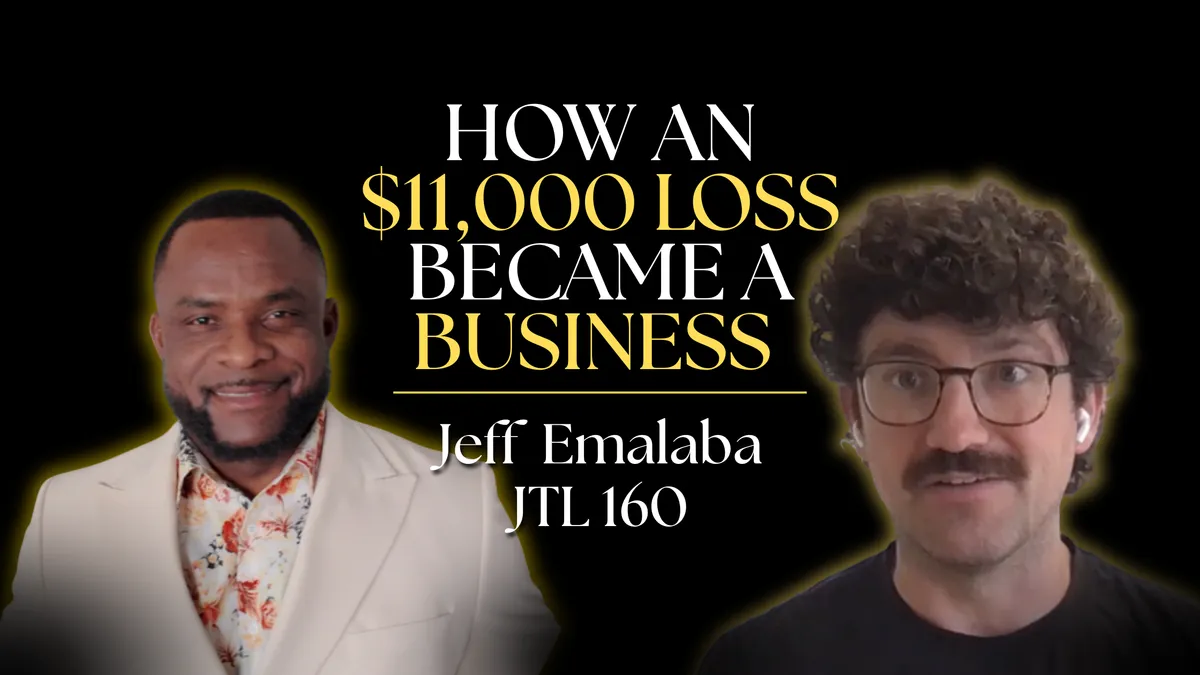
How to Find Your Passion in Business | Journey to Legacy
Want to hear the full conversation? Listen to the Journey To Legacy podcast Episode 160 with Jeff Emalaba for even more insights and stories from his remarkable entrepreneurial journey.
How to Find Your Passion in Business: Pick Your Problem
Opening a coffee shop sounds lovely until the fridge breaks before the breakfast rush. Photography looks glamorous until a client requests another round of changes.
Every business comes with work you probably won't put on your vision board.
If you're wondering how to find your passion in business, try identifying a problem you care enough about to keep solving. Then test your interest through a small piece of real work, including the frustrating parts.
Jeff Emalaba's experience offers a useful example. On Journey to Legacy, the InvestFusion founder told Wayne Veldsman how an expensive property deal gave him a problem worth working on.
Look for a problem that keeps your attention
Jeff says he'd committed more than $11,000 to a duplex deal in North Carolina when an inspection revealed serious defects. The inspector's advice was blunt: run.
A contractor estimated that repairs could cost another $25,000 to $55,000, without guaranteeing a lasting result. Jeff walked away from the deal.
He still cared about real estate. What bothered him was the process: buyers could spend thousands before discovering problems that would have changed their decision.
That experience led him to build InvestFusion, a platform designed to help investors identify potential property risks earlier.
His story gives aspiring entrepreneurs something specific to consider: the problems that hold your attention can help you decide where to put your effort.
Choose your favourite headache
When Wayne asked how someone could recognise a passion worth pursuing, Jeff connected it to caring about the work enough to continue through challenges.
That offers a practical test for a business idea.
Picture an ordinary difficult day in the field you're considering. A photographer might spend it managing revisions. A software founder might spend it investigating why a feature keeps confusing customers.
Consider whether you'd still care about getting that problem solved after the initial excitement faded.
You can be irritated by a task and remain invested in the result. For Jeff, the result was helping buyers understand a deal before committing their money.
Our conversation with Jonathan Domsky about finding your purpose explores how practical experience can help clarify your direction too.
Test your interest through real work
Give yourself a small experiment before making a large commitment:
Name one recurring problem. Be specific about who experiences it and what makes it difficult.
Speak to someone dealing with it. Ask how they currently handle it and what they'd like to improve.
Try helping with one small part. Offer a simple service or make a rough version of a solution.
Notice your response. After encountering a difficulty, are you interested in understanding it better and trying again?
Make the experiment small enough to finish this week. You could simplify a confusing form for one colleague or help one customer compare their options. Keep a note of what they found useful.
Use what you learn to decide whether to continue, adjust the idea or explore another direction. A useful experiment gives you information, even when the answer surprises you.
Let your approach change
Jeff's interest in real estate eventually led him into building software. His method changed as he understood the problem better.
As he explains in the interview, "You can change along the path."
Finding your passion in business can involve that flexibility. Choose a problem that matters to you, try helping someone with it and pay attention to whether the work makes you want to keep learning.
Hear more conversations about building meaningful businesses on the Journey to Legacy podcast.
TRANSCRIPTS:
WAYNE:
most people wait until almost everything is perfect before they start a new business, and today's guest says that that is exactly what is holding you back. Welcome to Journey to Legacy. I'm your host, Wayne Veldsman, and my guest today, Jeff Emalaba, started his first company as a teenager and went on to analyze global market trends on Africa's leading TV network.
Years later, a painful loss on a real estate deal cost him more than $11,000, and it could have ended his entrepreneurial dreams forever. Instead, it became the reason he built his company, Invest Fusion, a platform now known as the Carfax for real estate that helps investors see the risks in a deal before they ever commit.
Today, we talk about turning a setback into a business, how to find a problem worth solving, and what legacy truly means to him. Let's jump right on in.
Jeff, first off, thanks for taking the time to be here today. I'm super excited to chat with you. I like to, to kick off with this question of everybody that's listening, why should they listen to you today? What makes you credible?
JEFF:
Very good. That's a very good question, Wayne. Thank you once more for having me and for our listeners out there, our viewers, wherever, uh, platform you're watching this or listening to this, if you get anything of value, please go leave Wayne here a five-star review. Now, what I do, my name is Jeff Emalaba.
What I do is to protect real estate investors, um, from losing thousands to non-refundable fees or even earnest money deposits on properties they are never going to own. That's what sets us apart. See, the reason is pretty simple. Most real estate investors, what they do is to go on the regular listing sites, and they see a property, they put it on contract, they go on inspection, they pay the appraisal, they pay for, uh, the inspection fee, they pay the non-refundable due diligence fee, they pay the earnest money deposit.
Now, it's during the inspection phase, they now realize, oh, there's issues, there's foundation, there's structural. Then they are forced to do what? To back out of those deals. So my job is to protect investors at the deal level before they lose thousands. That's what makes me separate from the rest of the players in this industry.
And you know, it's because from a personal experience, it's something I've done in the past, and I understand this. I understand the pain points. And every day, Wayne, I'm gonna be very blunt with you. I run into investors, I run into everyday investors who tell me their story, how they lost money from real estate agents buying a brand-new property, from regular investors who've invested money, they see that they run into issues, and then they back out of deals.
So we want investors to be, to be very aware, to be-- to know what they are getting themselves involved in. And that's why we do it differently. And that's what, you know, that brought me into this, uh, space as an agent, as, as, as a, you know, as an investor, um, one who wants to provide guidance for our inve- for our listeners, of course, and one who wants to give them, of course, the sure path to, to understanding how to create generational wealth.
WAYNE:
Nice. Jeff, I like how you put it that you are here to protect investors in the real estate space. So you
JEFF:
Correct
WAYNE:
bit that, you know, you've come across some losses yourself in the past when trying to make some
JEFF:
Yes
WAYNE:
Take us, take us back a little ways earlier in your career. Like, I'm curious what brought you to where you are today, and again, like your experiences that have built you up to be credible and qualified in the space.
JEFF:
So almost, almost 30 years ago, um, I used to be the kid you see analyzing global financial markets in CNBC Africa. I was doing this daily on the TV, um, analyzing the markets. So my background started from risk. I got my first, uh, license as an options trader in 21st Century Options in Florida. Uh, so I understand risk.
I understand risk transference, risk mitigation, and all of those, uh, uh, what have you. Now, one of those days on my drive, I was driving away from the studio, and I saw this book on real estate in traffic. So I bought the book. I was just a young twenty-year-old kid, you know. I was curious. So I bought the book, I read through it, and I understood that yes, real estate makes sense.
It's a human need. It's something that everyone would need. And so during that phase, I asked myself, "Jeff, you cannot do this alone. You need a mentor." I needed somebody who can give me guidance, who can show me the right path to doing this. And I found a mentor, luckily for me, whose story resonated with me.
He has gone through the same pains, like w- worse than I've ever had. So I understood his story, and I-- that resonated. So now I followed through what he told me. He said, "Jeff, make sure to get your license in North Carolina. Just go get the license. Even if you're not an agent, go get the license." And I did all-- I did everything my a- my mentor told me.
Now, this, the reality on the ground is you think it's always gonna be, uh, the blue pill. It's always gonna be the blue pill. There's no red pill. No, there's always gonna be challenges. And we had our own fair share of challenges. My own challenge started some years back. Now I got... So I'm more into the multifamily space.
So I bought a duplex. I found this in Valdese, North Carolina. I went with my agent. We did our walkthrough. Uh, everything checked out what the seller... And that's what most investors do. They go in, we trust what the seller has told us on the seller's description. They have the buyer's disclosure document.
They re- they tell us what they want us to know. So I went with my agent. We did our walkthrough. Everything checked out. There was no issues. So I went under contract. I paid my $5,000 for my earnest money deposit. I paid $5,000 for my non-refundable due diligence fee. I paid for inspection. I paid for appraisal.
In total, over $11,000 on the line Now, during that inspection phase, the inspector had some issues, family-oriented issues. And so the wife was in the hospital. He could not go do to-- So in real estate, there's what they call the, the, the inspection period. So he could not go on time to go and get that inspection done, which I understood his pain point.
And because life happens, my agent also failed to extend it. Now, the seller refused the extension. So when the inspector eventually got, went in to inspect the property, he said, "Jeff," one word, "run." I said, "What do you mean run?" He said, "Everything is wrong with this property." I said, "Tell me." He sent me the report.
Foundation issues. The property has structural damage. They had roofing issues. There's mold and mildew under the crawl space and plus electrical problems. And so when I saw all of that, I sent the report to the seller. The seller refused. Seller said nope. So he said no. We selected no representation. Now, what that term...
So if you look at a buyer's disclosure document, there is a clause or there's a loophole there that's, is called NR. NR means no representation. What that means in essence is the seller can be aware of a material fact and fail to disclose it, and is legally allowed to go ahead and put that property on listing sites and never disclose material facts.
And so when I called in a general contractor, because I not, I did not take it seriously with the inspector. I have to call in a GC. I said, "Come in, go and check this property, see what I can do to own, to take ownership," because my money is already on the line. The general contractor went in and said, "Jeff."
He said, "Jeff, listen, if you're not willing to spend anywhere from twenty-five to fifty-five thousand dollars, just back away from this deal." And he's not guaranteeing the result will gonna be sustainable. So that was my experience, and that's shaped who I am today. Like I said, like I said before, my background is on risk, risk transference, risk mitigation.
So I asked myself, "So if buyers are going into deals like this and nobody's protecting them, how is this allowed?" And then I, I... So this was funny, Wayne. I was reading a report from Redfin. Redfin is one of the top news outlets that o-on the real estate space. Redfin collected a data monthly, and in the month of February, they said over forty-two thousand deals collapsed If you go on that report, it's on...
Anybody can Google this. Just go and Google number of canceled deals in the US. Redfin says over 42,000 deals collapsed in March. In April, it was 56,000 deals. And among these issues they cited is buyers going into deals and finding out structural issues, foundation issues, roofing issues. Those kind of issues in real estate, we classify them as big-ticket items, BTI.
And so buyers are not getting protection. And that's why w- I said to myself, "Listen, whatever it takes, if nobody has stepped up to provide a solution in this space at the deal level, I have to be the person who step up and provide a solution." That's why right now my users, our investors call it the Carfax for real estate because they understand that, that analogy.
You know, you want to buy a car, what do you want to do? You want to know, can the car move? I mean
WAYNE:
S- so you, you just mentioned it perfectly, so let's just go ahead and dive in real quick. So Invest Fusion is your software, right? And you just described it as the Carfax for real estate. We're gonna backtrack on your story in a second, but tell everybody what, what is Invest Fusion? What, what does it do?
What are you guys working on?
JEFF:
So what it does, what the platform does is this, like I said, Carfax for real estate. It goes behind the scene before you leave your home, because time is of the essence. You want to save your time, you want to save your money. Two things that matters most to you, and that's where I'm coming from. So before you spend a dime, what the platform does is this: it goes behind the scenes.
So if you go to any properties, it covers all three asset class, from single family units, from multifamily units, and from commercial property. It goes behind the scene and lets you... It pull out any available report that was done. So if an inspection was done on a property in the past, and the seller is aware of issues of their own property and refuse to disclose those issues, guess what?
The platform is gonna pull that report out and let you know, even from government sides. So if they have any liens, any encroachment that government data has flagged and they refuse to, to disclose those material facts, the platform is gonna pull that report out. So five key areas. Number one, it tracks for any risk.
So you want to know what are the risk I'm getting myself involved in. So risk like foundation issues, structural damage, uh, maintenance needed, roofing issues, and environmental risk. That's number one. Number two, you look at the financial matrix. You want to know, am I buying a discounted property? So it flags and looks for a property that's thirty or forty percent below replacement cost or below asking price.
Not, not above replacement cost, not above asking price. That's number two. Number three, this is extremely important. It pulls the previous appraisal report. Now, if you know nothing about real estate, the appraisal report is a mandatory report your loan officer will ask you to go and do, because it's what gives the loan officer the justification for approving the loan to you, the buyer.
And the appraised report is done from a professional, an unbiased report, that lets you know what the true valuation of that property is. So you want to know, am I buying above the appraised report or below the appraised report? Now, if you know anything about real estate, if you buy below the appraised report, we call it built-in equity.
So in a simple example, let me use Sarah as an example so that you understand what this platform does in holistic picture. Sarah is one of our students. She's a single mom with six kids. She has two jobs. By day she does one of the jobs, and by night she does the other job. Now, Sarah called me and said, "Jeff, listen- I have done what people can-- most people cannot do."
I said, "What did you do?" He said, "Jeff, I've scraped, I've scraped, and I've scraped. I've put together over fifteen thousand dollars." But he said, "Jeff, listen, I am not in the game of losing my money. I want to find the right multifamily duplex." So what did Sarah do? Sarah, the fifteen thousand dollars, that money represented everything for her.
Her missed vacation, her sleepless nights, you know, her children's sacrifices. So I understood where she's coming from. Sarah went and used the platform to find a duplex. The duplex had over twenty-five thousand dollars of built-in equity. What that means in essence is she found a duplex that the appraised value is above the asking price by twenty-five thousand dollars.
That's number one. Number two, it was discounted. So she find something. She found a duplex in her city that was discounted by thirty percent below replacement cost. Today, Sarah rented one unit. She gave out one unit to a tenant, and she's living in one of the units. She's living debt-free. She's living, you know, stress-free, and she stopped doing the two job but only had retained one job.
So the platform is able to do all of that heavy lifting and give you a deal score. Plus, there are so many things. It, it hits over four hundred data points. So in an instant, you can tell, am I buying a landmine or am I buying a goldmine? So you want to know, is it, does it make sense? Does these numbers make sense?
So it looks at the financial metrics. It looks at the, the behind-the-scene event on that property that you as an investor would not necessarily have the ability to go and do on your own. So it looks... So like I said, on commercial property, it does a whole new beast entirely. So Wayne, that's some of the... So the platform gives you access to know, is it deal?
Does it make sense in the first place or does it not make sense? Just the way you use Carfax to go and check.
WAYNE:
You know, I th- I think saying it as the CARFAX for real estate is, is really great, right? It's the things, it's
JEFF:
Absolutely. And that's what, and that's what we, that's what clients call it. The clients are the ones that give it the name.
WAYNE:
No, it's great,
JEFF:
Who am I?
WAYNE:
providing the report that potentially the seller doesn't have to, right? As you said it yourself, like legally, they don't necessarily. There's almost a loophole where they don't have to disclose everything. And so this is truly providing the complete transparency for a property
JEFF:
Correct
WAYNE:
individuals pretty much don't end up like you did, Jeff, right?
Where you have
your non-refundable deposit in, you're paying for the appraiser or the surveyor all to come back and essentially tell you, like, move forward with this." And, you know,
JEFF:
Yes. Yes.
WAYNE:
because you end up losing eleven thousand plus dollars. it's better than, you know, making a terrible investment that would've cost you, what, thirty, forty, fifty thousand dollars in repairs before being able to get it
JEFF:
Correct
WAYNE:
But still, you guys are providing that risk protection, uh, for investors before they ever go in, and really great story there as well. Now, I'm curious, take, take
JEFF:
Absolutely
WAYNE:
the way. You're originally from Nigeria. You mentioned that you were a
JEFF:
Correct
WAYNE:
spokesperson on CNBC Africa. Like, where did your career start, Jeff, that you landed that position? And also, I'd love to
talk about, sorry, how you got into entrepreneurship in the first place, 'cause we speak to a lot of new entrepreneurs on the show
JEFF:
I think our reading, reading books, reading books on leadership, reading the stories of entrepreneurs is very, very vital. I would say when I was just in my early teens, um, I started my... I had my first company and I-- before that even started, I'm always having that curiosity. I wanted to know. My first thought was: how do the wealthy people grow wealth?
How do they grow wealth? How do they become so sus- how does wealth sustainable? How is it developed? How is it built? And I started reading books. One of the books that changed my whole mindset was on Brian Tracy book called Goals. If you've not read that book on Brian Tracy, go read that book. That book shaped my thinking, shaped my mindset.
It defined who I am as a person. It makes you think in the present tense. It said, "There is no obstacle that you cannot overcome." And so when I started my early career, I used to read a lot of the business news outlets. And so it's so funny, you're taking back, back to a story that no one has ever asked me when.
Now, when I first got my license here in options trading in Florida A top business newspaper reached out to me and said, "Jeff, we want you to contribute on our paper as an editorial contributor on options trading." Now, in the whole of Africa, nobody's trading options. So I asked myself, "How do I interpret options to, in layman terms, so the listeners or the readers can understand it?"
Guess what I use, Wayne? I use insurance because options is about ins- it's like ensuring that something does not go wrong with your stocks portfolio or your exposure. And so they could understand, okay, insurance, and then they understood options. And that's how I started in that space. So back then, I had my company, all my younger ones worked for me.
You know, I was on TV, I was on Nigerian TV, in Channels TV, analyzing financial markets, of course, covering the global financial markets. So I traded derivative instrument, commodities, futures, all of that good stuff. Now, during that period, I knew the markets are unpredictable. When we ran into the meltdown in two thousand and seven and two thousand and eight, I realized that, oh, markets are so unpredictable.
Yes, you can make a lot of money. You can lose also a lot of money. So I asked myself, "Where is the sure part?" I don't want to go into deals that you, you're not sure. You have no control. You know, you have... You're at risk at the market. You're at the mercy of the market. I said no. And that's when I asked myself.
So with my reading skills, my knowledge in, in... By reading, I dived myself into understanding wealth, and I realized something. Most investors, most millionaires build their wealth from real estate, and that just made sense. When I realized that, oh, wow, okay, this is a human need. This is something that everyone needs.
It's not gonna go away tomorrow. I asked myself, "How do I become the best at this space? How do I get to know it and know it very well? Who will I choose as a mentor?" And he one hundred percent is one of the biggest players in our, in the US right now in real estate. So he taught me the ropes, taught me everything, how to grow wealth, how to...
In fact, his own story, we lost a lot of money in the past as well. So he's told me, showed me all the ropes. And today, I can tell you one hundred percent that once you understand how to play the multifamily space and you go into commercial, you will know that that's where the big bucks lies, and that's where the big players are playing the game
WAYNE:
Well, I, I love how you started this with talking about reading, right? Learning the stories of other entrepreneurs, where they started from. Curiosity is so important. We talk about it on a lot of interviews that I do, that entrepreneurs say that curiosity is the number one trait and factor that have gotten them to where they are today, 'cause they just go and learn and then come across a challenge or a roadblock or an issue, and they're curious how to solve it, and that's what takes them down the path of funding their business. And for you, it was this curiosity of: how is wealth built, right? And how is
JEFF:
Correct.
WAYNE:
maintained?
JEFF:
Correct.
WAYNE:
And that's when you actually found real estate. So as you say, it's like the majority or, yeah, more millionaires are made through real estate than any other industry because everybody does need it. It's not something that's going to go away tomorrow.
So Jeff,
JEFF:
Absolutely
WAYNE:
somebody listening right now. They've been working a corporate job. They're unhappy, and they wanna get into entrepreneurship. Where's the best place for them to start when they've never had a business before themselves?
JEFF:
So if you wanna start, um, the very, the very first step is to understand what is it, what are you trying to solve? What is that inherent problem you are trying to solve? And that problem must be big enough that it will impact a lot of people, but you find a unique way to, to do two things: save them time, save them money.
If you can find that problem that you yourself listening to this right now, you already, you are passionate about it. You already love that particular field or that industry, but you identify a problem in that space. The question you have to ask yourself is, how do I solve this problem faster and with less money?
How do I make people spend less and get the result as quickly as possible and as efficiently as possible? Once you can identify that, that starts the foundation of your journey. Number two would be now how do you get yourself structured? So you need to form an LLC. You also need to structure your LLC because you cannot do this alone.
You need leverage. Leverage come from the banks. The banks want to see that you are structured. So the banks will not want you to start off... Now listen, if you're listening to this right now, if you say, "Jeff, listen, I don't even have anything to start with right now. I don't have zero cash." That doesn't matter.
What matters is how you structure your LLC. Once it's well-structured, that means don't use your home address as your business address. Don't use your four oh- your, your, your regular mobile number as your company's number. You w- need a one eight hundred number. Once you structure all of that, then the banks see you as serious.
The banks see you as an entity, that you are serious. They can now grant you funding because you need access to fund to do a lot of this stuff. And so once you understand that point, as an entrepreneur, don't go in blindly thinking it's all gonna be rosy. There will be challenges. That's why I said at the outset, if you love what you are planning to do, if you love it, when the challenge come, you will overcome that.
That's why I said I refer to the book on Brian Tra- Brian Tracy's book on goals. You have to sp-speak in the present tense. It means project five years from now, this is where I want to be in my business. In the next five years, I am already do- so you put it in the present tense. It will wa- it will ward off all of those challenges.
I am already doing this. I am alread- for me, Wayne, I'm gonna tell you something very funny right now. I've never said this before on any show. I was just turning 25 years old, and I said to myself, after reading that book, I said, "How do I implement this thing I'm reading?" So I printed out a newspaper from my computer, and I said Some months down the line or some years down the line, I'll be earning a million dollars per month.
Guess what, Wayne? In my brightest idea, there's no way on the planet I knew how I'm gonna get even $100,000 there or even a million dollars a month. But that was my mindset. That's why I said I want to earn a million dollars per month and I'll be good. Guess what? When you speak it into, when you speak it into belief, everything pulls into you.
You... The kind of people you meet, the people, the re- the, the, the contact you will have, guess what? They will channel you towards that goal. That's why I said speak in the present tense. Don't be afraid to, to shock yourself. If the goal is not big enough to shock you, then it's not a goal. It's just a dream.
So you have to be big enough. And again, the obstacles will come. Once you can wait through those obstacles, then you are set yourself for success unimaginable . And that's how it goes, my friend
WAYNE:
The obstacles will 100% come. Um, I think these are just really great actionable tips here that first off, right, focus in on a problem, a real problem, and then of course flip it upside down and start to find a solution. And a great
JEFF:
Yes
WAYNE:
is like a problem that your solution now is saving people time, it's saving people money,
JEFF:
Money
WAYNE:
great place to start. You, you talked about passion, A lot
JEFF:
Yes
WAYNE:
get hung up on passion. They think, you know, "Oh, I have this idea, but I don't know if it's my, my passion or my purpose," and it stops them from ever starting. Jeff, how does somebody even know if their passion is, is real, if it's worth chasing?
How do they know what their purpose is? And also it's like, is that something that can change over time? 'Cause I want us to get people to get going today, quit waiting until everything is perfect. What would, what would you say to those people?
JEFF:
I like what you just said right now. Your- don't wait until everything is perfect. Now, when you... This is how to understand this. That's why we said read, read, and read. The more you read, the more you digest. You, you read because reading does two things for you. You know the minds and the thinking of the author.
When you begin to read, it opens up your mind to who you are as a person. Read good books, read books, read stories, read stories of people. That will shape you into understanding what do you want to do as an, as an individual? What do I want to do as an entrepreneur? When we talk about passion, passion is something you must love.
If you don't love it enough when the challenges come, then you're not really gonna be doing it. Because once you run into obstacles, you're gonna back away from those. So you have to understand, do I love this enough that even when the challenges come, you said, "You know what? I'm still gonna go ahead and pursue this, this."
That is what will drive you. That's, that's the driving force. That's why you s- I said you need to set goals. You need to know, where am I going to get to? Where am I trying to get? What is my direction? What is the path I'm going to take? Now, is it cast in stone? No. You can change along the path. My own story, I changed.
Why? I bought a first... I bought my first... Years ago, I bought my d- I bought my first duplex. I ran into issues. Did I just go in and cry and sulk and sulk and sulk and call my mentor, "I lost money. I'm crying here"? No. I asked myself, "Okay, fine. There's a loophole." You know what's funny, Win? Back to my story When I confronted the seller, I also...
Because I'm also an agent here in North Carolina, I reported them to the North Carolina Realtor Association. These guys took down the property on Zillow, and two weeks later, Wayne, they re-listed it without disclosing material facts. So I have been burnt already. Another investor will do, is gonna be burnt next because they disclose, they never disclosed any material facts.
So if you're listening to this right now and you are going through challenges, it's not gonna be a straight path. There might be challenge along the line. Now we are in the world of AI. Ask yourself, "How do I make this faster? How do I make this quicker? How do I save money? How do I get people to get this done?"
I run into developers, I run into individuals who are planning to own their own firm, Wayne. These guys are telling me now they're using AI to do almost all the heavy lifting for them. So you have to think, as you start your journey, as you start your entrepreneurial journey, you will run into challenges.
But how do you overcome those challenges and how do you leverage technology? Because we're in a world now, look at this, my car drives itself, takes me home, takes me to work, brings me back. We are getting to the stage where we are now all just relaxing and allowing technology do everything for us. So you're gonna get, have to embrace technology in your own s- in your own field or in your own industry.
Whatever it is you are trying to get yourself involved in, you have to understand that the challenges will come, but when they come, it's not a straight path. Sometimes you will take a deviation, but you know your end goal. You know your journey. You know where you're getting to. You might take a deviation, but you're gonna get to that part.
So deviations are allowed. Like I, I took a deviation to go and build this platform that Wayne and, Wayne and I are talking about today, that my clients say, "Jeff, you've just built us the Carfax for real estate." And I, I will tell you something, Wayne. There is no tool in the US that protect buyers at the deal level.
That means it does not exist until now. So if I have suffered something... And I'm, I love the real estate industry. My kids see me, I talk about real estate all the time, so they know I love it. They know. They can see. They can feel it. If there was a challenge, the next question I have to ask myself, "If I love this industry and I'm, I'm not gonna back away from this industry, how do I solve this problem and keep going?"
And that's my own... So my own story is a living testimony. If I'm a living proof that there will be challenges despite years of experience, over 25 years experience in real estate. And Wayne, this is so funny. Every day I run into individuals, regular people. I will tell you a story of an agent right now because you, you, your, this is about story.
Let's talk stories so people understand what others have gone through. This is a real estate agent, an experienced real estate agent. She bought a brand-new property, so this is brand new. You know, people just have the assumption, "Oh, it's a brand-new deal. I don't have to do anything. No need for inspection.
No need for all of those good stuff." Her child is in a wheelchair. So the way they build those homes with wheelchair is the ramp. So the ramp allows her to, to, to slide that wheelchair in. So she... Six months after they bought that house, they never did any inspection. They never did anything. The builder assured them everything was fine.
The lady, the, the daughter in the wheelchair, she noticed because she's on the wheelchair, the hardwood floor, she noticed one side of the floor was caving in. So she called her mom and said, "Mom, come and check. There's something is wrong with this side of the house." The mom saw it. She called the builder.
The builder said, "Don't worry, everything is fine." She called an inspector. The inspector came and did an inspection on the property and realized that they had structural problem on that property. The foundation is weak. She called the builder and said, "Hey, this is what the inspection said." She sent the report.
The builder and her, as we speak right now, they are still in court. The builder refused and said, "Well, we are sorry. Your money is gone. There's nothing we can do. This is the issue." They are still in court debating on that issue. So even for a brand-new deal, you can run into issues. The point is, at any l- layer on this game you are playing, at any side of the journey you are in, there will be challenges.
Your goal is: how do I turn that challenges around? How do I put it into my advantage? How do I learn from it? How do I m- how do I monetize it? How does it make sense for me? And then you can continue your path. Because all of us here, Win himself, here, have gone through an, a challenge before in his past
WAYNE:
Oh, endless. And you know, Jeff, that's kind of where, that's kind of where the podcast Journey to Legacy came from, is that it was a way for myself personally to learn from other entrepreneurs' challenges that they have faced, how they overcome them. And, you know, often it's not even a learning per se, like, how did they overcome the challenge?
What did they do so that I don't make the mistake? much as
it's examples of these seemingly really smart, really wealthy people, but it's just examples that they also are finding challenges. They're coming across challenges, and they're deciding to just keep moving forward, work their way through it. You know, there's this,
JEFF:
Yes.
WAYNE:
quote of like, "The only way to fail is to actually give up," right? Otherwise, it's just a
challenge and a setback, and then you find your way
through and you keep going. The only time you fail is when you actually totally, totally give up. Um, Jeff, something else you mentioned a little while ago is that you talked about, one, have passion, and then two, have big goals. read something
this past week that was describing how simple problems or lower-tier goals seemingly are easier to solve, because of that, there's more competition. More people can see like, "Oh, I could just solve that also." And now there's tons of competition at this sort of middle level of call it just like normal problems, normal-sized goals. if you elevate your thinking and you decide, "I'm gonna tackle something really big, really challenging," not as many people competing for that space. Right? It's like, Jeff, we're gonna take Invest Fusion, what you're working on here as an example, right? a reason why this software didn't exist.
There's a reason why something like this
JEFF:
Yes
WAYNE:
on the market, 'cause I can guarantee it's not easy to pull all this information. It's not
JEFF:
That's right
WAYNE:
get the sources and the credibility, and so it didn't exist. And for you, you decided, "Let me find a huge goal," and all of a sudden there's not that much competition. And when you come across problems and struggles, you're excited to work through them and solve them because there's a potential for a huge payout instead of
JEFF:
Yes
WAYNE:
"Eh, it's a problem. I don't... Oh, it's a challenge. I don't really wanna solve it," because the payout at the end isn't big enough, right?
JEFF:
That's right.
WAYNE:
Big goals, big challenges is the direction that we need to go, that we need to face.
JEFF:
Let, let me tell you something quickly, uh, Wayne, because as you're speaking right now, um, when I... So some years back now, some few years ago, I used the platform. But so before we even came to market, what I did was to reach out to all the stakeholders to validate the accuracy of the data we are pulling out from.
So we reached out to loan officers, we reached out to, uh, inspectors, we reached out to general contractors, reached out to all the top real estate agents here in the US. We said, "Go and beta test it." So before it came live to market, we beta tested it. Now, what I did was this. When I f- when I ran the platform through a, through the deal here in North Carolina, it found one property and gave it a deal score.
So you have a score. Anything above fifty is gonna give you the reasons why it thinks that deal was worth it. So it gave me a duplex, sixty-five percent. I went in, I c- I called my agent and said, "We found a deal." Within seconds, I don't have to s... The, the s- the confidence level is back. The stress level is gone.
The, the thinking, "Am I gonna make the mistake, same mistakes twice?" is gone. I called my agent. We went in. We immediately, we went ahead. We paid for their, we paid their, their fees. We paid inspection. We paid appraisal. Everything was seamless. When we called... When the inspector came to inspect the property on video, he said, "How do you find this property?"
"Everything checked out. Everything is good." I started laughing. So for our listeners and our viewers, the reason why I went through the pain, like what Wayne had just described right now, if you're listening to this, was because I knew that everyone mo- uh, let's, so let me take it back. Most of us in real estate, we are blind, not because we make a bad decision.
We are blind because the tools we have are not designed to protect us. And so I asked myself, "Jeff, if you are teaching your kids to pursue real estate, and you are going into these deals blindly, you just had one loss. How many times in your lifetime would you have those losses? Can you recover?" Wayne, my mentor lost five million dollars on one commercial property.
So let that sink in. If you think you're too big, let that sink in What did I do? So we built a platform that protects us from that same loss that my mentor has also gone into in commercial deals. So it's built with over four hundred data points, so you know what you're getting yourself involved in. And that's why I, I said this over and over again.
If for me, without this platform existing, I cannot go into deals. So I use it for myself. The, the, the cherry on top of the icing is that we cannot give it to you listening to this right now. You can try it. It doesn't stop me from using my plat-- using the platform to run my deals because it's just something that if I want to keep to myself, I've already built it for myself.
But I said to myself, "You know what? Let others buyers." Because if Redfin says, "Jeff, there are forty thousand buyers who are going into deals collapsing every single month." In a day, that's over fifteen hundred buyers. That's a lot of buyers going into deals. And it's the tools that they have. They have the Zillows, they have the listing site, they have the Crexi, they have the LoopNet.
That's all they have. So it's not just about ARV. It's not just about let me go and tear down and build up, and build back up. No. You have to ask yourself, it's like buying a car. If you want to buy a Rolls-Royce, you want to buy a Rolls-Royce with no engine, or you want to buy a Rolls-Royce that has an engine, it's functional, but the buy-- the, the seller is distressed.
That's what you want. You want to buy a good deal, but a distressed seller, not a house or a vehicle that has no engine, and they tell you, "You know what? It's a nice Rolls-Royce, but there's no engine and there's no tires." And you want to pay a hundred and fifty thousand dollars on that Rolls-Royce. That's what buyers do in real estate right now, brother
WAYNE:
absolutely. How great is it that you a tool that solved your own problem, and that what you just said, that even if this wasn't-- even if you hadn't made it available to the public, it's really interesting to me that actually, you know, you, you made it because you're in the real estate industry that you love, and you want to make more money and protect yourself. And all of a
sudden, because of curiosity, you're like, "Well, shit, now there's this huge problem I need to solve to be able to protect
JEFF:
Yes.
WAYNE:
mitigate my
JEFF:
Yes
WAYNE:
You then, through curiosity, pretty much started a new business.
JEFF:
Yes.
WAYNE:
like, there's-- I forget the number now of the episode in the past, but there's so many instances and examples that we have of entrepreneurs that start down one path. Through curiosity, they then create brand new businesses and initiatives. Um, and for just like yourself, right? Like you would be using this tool yourself to solve your own problems. Even if you didn't offer it to the public, you would still be using it yourself. And Jeff, that's, that's just
JEFF:
Absolutely. Ab- absolutely, Wayne.
WAYNE:
in itself,
JEFF:
Absolutely. Absolutely
WAYNE:
really, really great. Jeff, as we start to wrap up, right, I appreciate all of your insights on entrepreneurship, right, and how people can get started, how they can protect themselves, mitigate their own risk.
JEFF:
Risk, yes
WAYNE:
to think a little bit into the future and the real purpose behind what we do, and that's where the topic of legacy comes up. And so I wanna ask you, what does legacy mean to you, and what's the legacy you're looking to leave on this world?
JEFF:
Very good question. I appreciate that question so much. Um, for me, uh, legacy is impacting lives. Um, I'll tell you a story because on May 19th, I get invited a lot across the US. May 19th, I was in Dallas, Florida, and, uh, Dallas, Texas, sorry. And when I was in Dallas, I ran into a, an helicopter, uh, pilot who trains other people to fly helicopters.
Like every of our listeners right now, this gentleman is an entrepreneur. He's a business guy, but he has no experience in, in this industry, in real estate. Himself and his friend, they put together over $15,000. They bought a house. They did- they never did inspection. Now... And it was just by the studio I went into.
So I ran into him in my hotel room. I was gonna have dinner, and we just started talking. He told me stories. Six months after they got their property, the house was sinking. They called in a GC. GC said, "Listen, guys, it's going to cost you guys over $85,000 because of the issues on that house." They have not been able to put that funds together to get that house repaired.
They're very close. They're very-- This is already their property. They have no choice than to fix it. Legacy for me is impacting lives, touching lives, touching people, changing lives, getting people to understand that there's a path to wealth. And that's why I said to myself, end to end. This is an end-to-end process.
How do I get someone who says, "Jeff, well, I am new. I'm a young, I'm a young entrepreneur. I'm a young business person. I have no money. My score is bad. How do I get started? How do I know? I don't even have the funds to even start thinking about real estate. Okay, I want to have a..." All of that, we've put all of that.
We've covered an end-to-end process. So I want to leave a legacy where people say, "This is the guy that helped me find a deal through his tool. Through his tool, I can now avoid those bad deals. I'm, uh, I'm creating wealth." Like the case of Sarah. Sarah would never have had that opportunity of finding a deal that not only will cash flow but also has built-in eq-equity.
Stopped doing two jobs. She has six kids. How can you be having two jobs, six kids? What time will you have for your family? So she going through the sacrifice, that pain point of putting the funds together, that for me is legacy. That stories, th-those examples of the stories, and that's what my, what my client said, "Jeff, this is the Carfax for real estate."
I didn't make that name. They gave me the name. So they un- So I, I feel the love. I feel the happiness. I feel the joy by most of our clients. And that's why I said to myself, "If I can touch lives, if I can just touch that one individual and change their life, give them the path to wealth, guide them through the process, I will be fulfilled.
I will be happy."
WAYNE:
Legacy, touching lives, impacting people. It's, it's a beautiful thing for me to hear, es- I'm gonna say especially in the real estate space, when someone
doesn't say legacy is leaving billions of dollars to their kids and their great-great-great-grandkids, right? Ultimately, yes, we wanna create generational wealth and leave it behind, that's not at the forefront of why we do it.
We're not creating a
legacy to have our name on a building or on a statue. It's all about impacting lives like Sarah, that she can now spend more time with her family because of the work that you're putting in and the real
JEFF:
Yes.
WAYNE:
that you're making on the world. thank you so, so much, my friend. For anybody that's interested in Invest Fusion and even yourself, where's the best place for them to go to?
Maybe e- even if they wanna try the software, where should they go?
JEFF:
So this is what we've done, uh, because we have run into a lot of our listeners, viewers who says, "Jeff, you know what? How do I start? Okay, I don't have money. Let me test drive this. You know, let me test drive this platform." So for our listeners right now, if you're listening, you're watching, please, like I said before, go leave Wayne here a five-star review on any platform you're listening to this.
Now, this, I'm gonna give you guys access to two things. The first one is for the next seven days, go and run any deal you have on InvestFusion. Go to investfusion.co. Go and sign up for seven days free access. Run any deal you have. Run anything you're thinking of. You have access to the premium features.
Now, if you're listening and you're watching and you says, "Jeff, I have no experience. I don't even know where to start. I have no money. My score is bad." I'm gonna give you guys for the first time, if you're listening to this, this is only exclusive to my platinum members, my highest paying members. But for Wayne and his team, I'm giving it to everyone listening to this for free.
This is what I'm gonna give to you. Our wealth coaching program covers the end-to-end implementation, what they call end-to-end side of the coin. From ground zero, you said, "Jeff, I don't have any experience. Okay, I don't even know where to start. My score is bad." From training materials, from how to build your credit score up, how to qualify for funding, how to create an LLC, how to structure your LLC to qualify for funding, how to find those deals, how to find multifamily units at a steal.
Plus, you get to work with me directly every week on a live coaching call. So if, for example, you have a deal and you're still not sure, you'll be on the live call with me. I will walk you through those deals. We'll make a decision on the live calls. Plus, we also have stakeholders who are also experts in this industry join that call.
So you have all of that for free. All you have to do right now as you're listening to this is go to investfusion.co. Go and sign up for the seven days access. Someone from my team will reach out to you and send you access to our private school community where the coaching calls are held. So you have all the end-to-end learning experience you need to grow your wealth, generational wealth, of course
WAYNE:
Yes, thank you so much. InvestFusion.co. Great. Everybody
JEFF:
Yes
WAYNE:
it out and, like, man, even just go to get knowledge about real estate from you in the community. Uh, that in
itself
JEFF:
yes
WAYNE:
valuable. Even for people that weren't ready to use this tool yet, go learn, right? It's what you said earlier.
to
JEFF:
Correct
WAYNE:
get curious, gain the knowledge around what other people are doing, and that'll
JEFF:
Ask questions.
WAYNE:
Ask questions. Ab- absolutely.
JEFF:
Right. You, you wouldn't believe when I was in the, um... I went to the immigration office to get my passport renewed, and this guy was asking me questions upon que- He refused to let me go. "Jeff, okay, how about this in real estate? How about this? How..." Oh, my goodness. I st- I... What I went there took me 15 minutes.
I spent one hour just answering his questions.
WAYNE:
Yeah.
JEFF:
One hour.
WAYNE:
great student in the community, That is,
JEFF:
Exactly. I'm telling you.
WAYNE:
Jeff,
JEFF:
Yeah.
WAYNE:
my friend. Thank you so much.
JEFF:
Thank you, man. Thank you for having me. Thank you for having me
WAYNE:
Thank you everyone for tuning in today, and thank you, Jeff, for being so honest about the hard parts of the journey. Here are my three takeaways for anyone building something of their own. First, start with a real problem, especially one that saves people time and money. Second, a setback is not the end.
Jeff's own loss became the starting point for his business. And third, don't wait until everything is perfect. Love what you do enough to push through the challenges and set goals that are big enough to drive you. For everyone interested in the software and the knowledge of InvestFusion, Jeff is offering our listeners seven days of free access.
Head on over to investfusion.co. And thanks again for everybody for being here today. For more episodes and to join the community, please visit journeytolegacy.org. Until next time, keep building your legacy


